An Energy Performance Certificate (EPC) is a bit like the multi-coloured energy label you see on a new fridge or telly. It gives a property a simple, standardised score for its energy efficiency, so everyone can see at a glance how costly it's likely to be to run.
What an EPC Rating Is And Why It Matters

Think of an EPC as a property's energy MOT. It goes beyond a simple letter grade, giving you a proper breakdown of how well the home holds onto heat and how efficiently it uses energy for lighting, heating, and hot water. In the UK, having a valid EPC isn't just a nice-to-have; it's a legal must-have for any landlord looking to rent out a property, whether that's a whole house or a single room to rent in an HMO.
For a tenant, that little letter grade is a massive clue about their future monthly bills. A place with a high rating, say a B or C, will be far cheaper to keep warm than one languishing with an E or F. That’s why a good EPC is a brilliant marketing tool when you're advertising your room.
Understanding The A to G Scale
The rating is based on Standard Assessment Procedure (SAP) points, calculated by a qualified Domestic Energy Assessor who visits the property. These points are then converted into the familiar A to G bands we see on the certificate.
Here’s a quick rundown of what those bands actually mean:
- Band A (92-100 points): These are the eco-warriors of the housing world. Typically new-builds packed with the latest tech, they have rock-bottom running costs.
- Band B (81-91 points): Still highly efficient and well above the average for UK homes.
- Band C (69-80 points): A good, solid standard of efficiency. This is a very achievable target for many older properties after a few improvements.
- Band D (55-68 points): This is the current average rating for properties across England and Wales.
- Band E (39-54 points): This is the big one. It's the minimum legal standard for almost all privately rented properties. Fall below this, and you can't legally let your property without a valid exemption.
- Bands F & G (1-38 points): These properties are at the bottom of the scale, signalling poor insulation, ancient heating systems, and eye-watering energy bills.
To help visualise this, here’s a simple table breaking down the scores.
EPC Rating Bands and Scores At a Glance
| EPC Band | SAP Points Score | Efficiency Level |
|---|---|---|
| A | 92+ | Very High (Lowest Bills) |
| B | 81–91 | High |
| C | 69–80 | Good |
| D | 55–68 | Average |
| E | 39–54 | Below Average (Legal Minimum) |
| F | 21–38 | Poor |
| G | 1–20 | Very Poor (Highest Bills) |
Essentially, an Energy Performance Certificate is the official energy label for UK homes. Each band corresponds to a score, and for landlords on platforms like Rooms For Let, an EPC is a legal necessity you must have and show when advertising to a new tenant.
The Value Beyond Compliance
While hitting that minimum E rating is crucial for staying on the right side of the law, pushing for a higher grade has some serious perks. A better EPC makes your room or property far more appealing to clued-up tenants who are keeping a close eye on the cost of living.
A good rating suggests a well-cared-for, comfortable home and can even help justify a slightly higher rent. For landlords with "bills-inclusive" HMOs, a higher rating isn't just a selling point—it directly protects your profits by keeping those utility bills down.
You can find more practical advice for landlords on our regularly updated blog.
How an EPC Assessor Calculates Your Rating
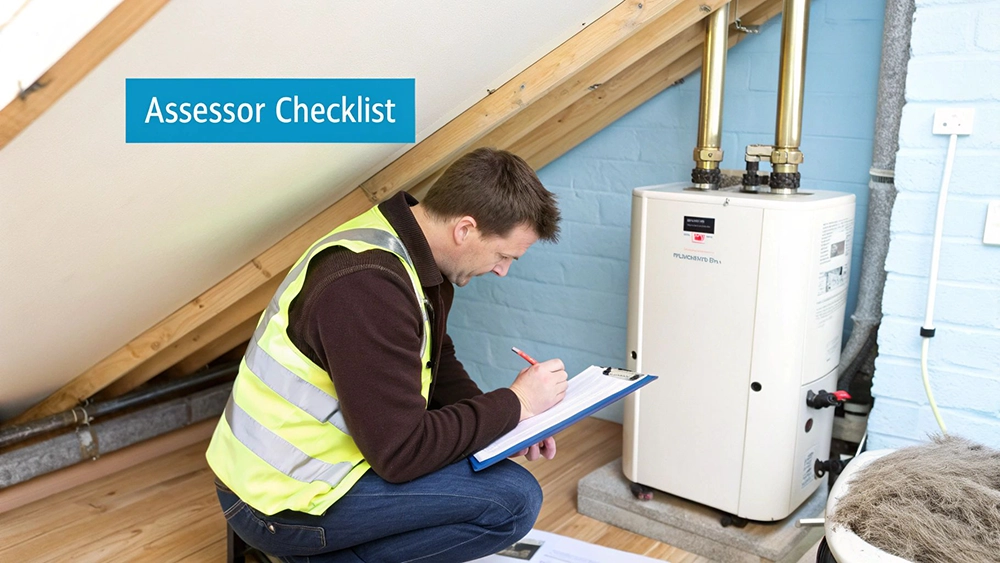
To really get your head around an EPC rating, it helps to see your property through the eyes of a Domestic Energy Assessor, or DEA. Their job isn’t to critique your interior design; it’s all about gathering hard data on your property's energy performance. They work methodically, room by room, feeding evidence into government-approved software that crunches the numbers and spits out the final score.
Think of the assessor as an energy detective. They’re on the hunt for clues about how well your property holds onto heat and how efficiently it creates it. They don't just eyeball things and make a guess; they follow a strict, standardised process. This consistency is what makes the EPC a reliable yardstick for comparing different properties.
First Up: The Building's Fabric
The first big area of investigation is the building’s thermal envelope—basically, the shell that keeps the cosy inside separate from the chilly outside. Heat loves to escape through walls, roofs, floors, and windows, so the assessor meticulously documents every one of these elements.
They’ll measure the property's dimensions and note its age, which gives big clues about the construction type. A Victorian terrace, for example, will likely have solid brick walls that leak heat much faster than a modern home with insulated cavity walls. The assessor logs this distinction, and it has a massive impact on the final score.
An EPC, in simple terms, measures how well a building can retain heat. Anything you do to improve its ability to hold onto warmth will boost your EPC rating. This is why insulation is the bedrock of a good score.
Next, the assessor will probably head for the loft. They aren't just checking if there's insulation; they’re getting out a tape measure to check its depth. The current recommendation is at least 270mm, and if you’re short of this, you’ll be losing valuable points. In the same way, they’ll check for floor insulation, which is especially important in older homes with draughty suspended timber floors.
Heating and Hot Water Systems
Once they've figured out how well the property keeps heat in, the focus shifts to how efficiently it creates that heat in the first place. The heating and hot water systems are responsible for the lion's share of a home's energy bills, making them a critical piece of the EPC puzzle.
The assessor will identify the make and model of your boiler to look up its efficiency rating. A modern A-rated condensing boiler is a huge point-scorer compared to an old, inefficient G-rated clunker. They’ll also check your heating controls:
- Programmer and Room Thermostat: Can your tenants easily control when the heating comes on and what temperature it reaches? Basic controls are a must.
- Thermostatic Radiator Valves (TRVs): Do most radiators have their own individual temperature controls? This allows for heating specific zones and stops energy from being wasted on empty rooms.
The hot water cylinder gets a look-in, too. An uninsulated tank is like a leaky bucket for heat, constantly burning energy just to keep the water warm. A thick, 80mm jacket is the standard the assessor will be looking for.
Lighting and Glazing
To finish their tour, the assessor checks off the smaller, but still significant, details. Windows are a key weak point for heat loss; they’ll count how many are single, double, or triple-glazed. The jump from single to double glazing is a big one and can seriously cut down on heat loss.
They'll also do a quick tally of the light fittings, working out the percentage of low-energy bulbs (like LEDs) versus old-fashioned, inefficient ones. It might seem like a minor detail, but swapping all your bulbs is a quick win that adds up. All this data, from the thickness of your walls to the type of light bulbs you use, gets fed into the software, which then generates your property’s final EPC rating, from A down to G.
Meeting The Minimum Energy Efficiency Standards
Beyond being a handy guide for potential tenants, your property's EPC rating carries real legal weight. The government has put a firm line in the sand for energy efficiency in the private rented sector, and it's called the Minimum Energy Efficiency Standards, or MEES. Getting to grips with these rules isn’t just good practice—it's absolutely essential for avoiding some pretty hefty fines.
The regulations are refreshingly straightforward. It is now unlawful to grant a new tenancy, or even renew an existing one, for any property with an EPC rating below E. This rule covers all domestic private rented properties, from a studio flat right up to a large House in Multiple Occupation (HMO).
When it comes to HMOs, remember the EPC applies to the entire building, not just individual rooms. If the property as a whole scores an F or a G, you cannot legally let a single room within it to a new tenant. This makes MEES compliance a critical checkpoint before you even think about advertising a room on platforms like Rooms For Let.
What Happens If You Don't Comply?
Ignoring the MEES regulations can be a very expensive mistake. Local authorities are in charge of enforcement and they have the power to issue some serious financial penalties if you're caught out.
Failing to comply can land you with a fine of up to £5,000 per property, per breach. This isn't a one-off slap on the wrist, either. If you continue to let a property that falls below the standard, you could face repeated action. The message is crystal clear: get your property up to scratch, or you can't rent it out.
The whole point of MEES is to push the worst-performing properties out of the rental market. It’s about driving up the quality of housing and protecting tenants from ridiculously high energy bills, placing the responsibility for basic energy performance squarely on the landlord's shoulders.
How to Check Your Property’s Compliance
Checking if your property is compliant is a quick, proactive step every landlord should take. It’s a simple case of making sure you have a valid EPC and that it hits that minimum E rating.
- Find Your Current EPC: If you don't have a copy handy, you can easily find your property’s certificate online. Just pop the postcode into the official government EPC register for England and Wales or the Scottish EPC Register.
- Check the Rating and Expiry Date: The certificate will clearly show the current rating, from A to G. Just as important is the 'valid until' date – an EPC is only valid for 10 years. You absolutely must have a valid certificate in place when you market the property and start a new tenancy.
- Take Action if Below E: If your property is rated F or G, you have to carry out the necessary energy efficiency improvements to get the rating up to at least an E before you can legally let it to a new tenant.
Qualifying for an Exemption
In a few specific situations, you might be able to register a valid exemption if you can't improve your property to an E rating. Be warned, though: the criteria are very strict and you'll need solid evidence to back up your claim.
Common exemptions include:
- 'High Cost' Exemption: If the cheapest recommended improvement needed to reach an E rating costs more than £3,500 (including VAT), you can register for an exemption. You must have official quotes from qualified installers to prove it.
- 'All Improvements Made' Exemption: This applies if you've already done all the recommended upgrades listed on your EPC report, but the property still stubbornly remains below an E.
- Consent Exemption: If you need permission from someone else – like a freeholder, a tenant, or the local council for a listed building – and they’ve refused, you may qualify for this exemption.
Exemptions aren't a free pass. You have to actively register them on the national PRS Exemptions Register. They typically last for five years, after which you’re expected to try again to improve the property's rating. Simply deciding an upgrade is too much hassle won't cut it; you have to follow the official process to the letter.
An impressive Energy Performance Certificate rating is so much more than a legal box to tick; it’s one of your most powerful marketing tools. In a competitive market, especially for rooms in shared houses, a good EPC can give your property a serious advantage, helping you attract a higher calibre of tenant who’s looking for a comfortable, affordable, and properly managed home.
Today’s renters are more clued-up on costs than ever. Young professionals and students—the core market for HMOs and room lets—are all too aware of soaring utility bills. When they spot a property with a C rating or higher, it sends an immediate, positive signal: this home is efficient, cheaper to run, and will be a warm, comfortable place to live without breaking the bank on heating.
Stand Out in a Crowded Market
Let’s be honest, the UK’s rental housing stock is dominated by older properties, which means a huge number of competing listings will have average-to-poor energy efficiency. For a proactive landlord, this is a golden opportunity.
Just look at the numbers. While performance is slowly getting better, many rental properties are still stuck in the middle bands. EPC data for England and Wales up to March 2023 shows a median energy efficiency score of 68 in England and 66 in Wales—both falling squarely in band D. A tiny 3% of existing homes have managed a B rating, while most are clustered in band C (35%) and band D (44%). You can dive deeper into the data with the Scottish Government's energy efficiency report.
For landlords advertising on Rooms For Let, this means improving from a common D rating to a C immediately sets your property apart from almost half the competition. By investing in energy efficiency, you aren’t just upgrading your property; you’re upgrading your advert. A higher rating becomes a key selling point, justifying your rental price and attracting tenants who value quality.
An EPC rating of C or above tells a prospective tenant that you are a responsible landlord who invests in the property. This builds trust from the very first viewing and suggests the home will be well-maintained in other areas too.
Protect Your Profits on Bills-Inclusive Lets
If you're offering rooms on a 'bills-inclusive' basis, the EPC rating has a direct and immediate impact on your bottom line. An inefficient property with a low rating can quickly turn a profitable HMO into a financial black hole, especially during those cold winter months when the heating is on full blast.
Think about it: an EPC of D, E, or lower means the property leaks heat. The boiler has to work harder and for longer just to keep things comfortable, and the energy you’re paying for is literally escaping through the walls, roof, and windows. This makes it incredibly difficult to budget accurately for your utility costs.
On the flip side, a property with a C or B rating is a much safer bet. Its superior insulation and efficient heating system lead to:
- Predictable Outgoings: Your energy bills will be lower and more stable, making it far easier to calculate a profitable and fair all-inclusive rent.
- Fewer Tenant Disputes: In a draughty, poorly insulated house, arguments over the thermostat are common. One person is freezing and cranks up the heating, while you’re worrying about the spiralling bill. A warmer, more efficient home keeps everyone happier.
- Increased Property Value: Beyond just tenant appeal, energy efficiency improvements increase the asset value of your property and future-proof it against upcoming regulations.
Ultimately, a good EPC rating transforms your property from a potential cost liability into a desirable, profitable asset that attracts and keeps great tenants. Improving your rating is one of the smartest investments you can make, and you can see how our platform helps you highlight these features by checking out our advertisement pricing options.
Actionable Steps To Improve Your EPC Rating
Improving your property's EPC rating is one of the smartest investments a landlord can make. It’s not just about ticking a legal box; it boosts tenant appeal, future-proofs your asset against upcoming regulations, and can even increase its value. The trick is to focus on the changes that give you the best bang for your buck.
You don't always need to spend a fortune to see a decent jump in your score. Many of the most impactful improvements are surprisingly affordable and can be tackled quickly, making them the perfect place to start.
Quick Wins and Low-Cost Fixes
Before you start thinking about major works, it’s all about the low-hanging fruit. These simple, budget-friendly fixes can collectively add valuable points to your EPC score and often pay for themselves through energy savings.
- Switch to LED Lighting: This is the easiest win on the board. An assessor will check the percentage of low-energy light fittings in your property. Swapping old incandescent or halogen bulbs for modern LEDs is a cheap, instant upgrade that can add 1-2 SAP points.
- Insulate Your Hot Water Cylinder: If you have a hot water tank, a new insulation jacket is a no-brainer. A new British Standard jacket should be at least 80mm thick and can cost as little as £20. It's a tiny outlay that stops heat from constantly escaping, adding another few crucial points to your score.
- Add Thermostatic Radiator Valves (TRVs): Fitting TRVs on at least 75% of your radiators shows the EPC software that you have an efficient heating control system. This gives tenants room-by-room control over their heating, which is a big tick in the efficiency box.
The infographic below shows just how much opportunity there is for landlords to stand out. Moving your property up a grade can put you significantly ahead of the average rental stock.
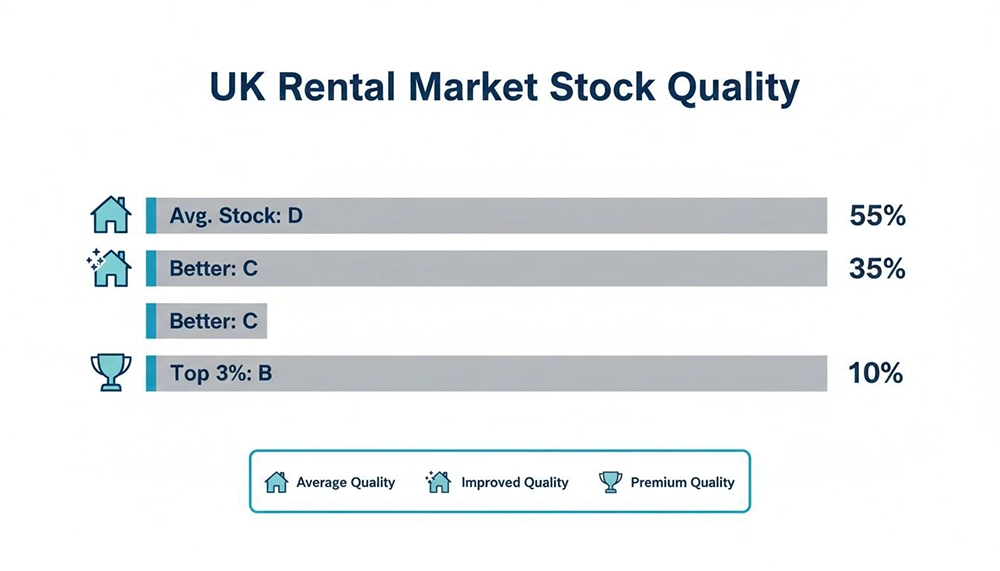
As the data shows, improving from a typical 'D' rating to a 'C' places your property well ahead of a huge chunk of the private rental market.
Mid-Range Investments with High Impact
Once you’ve nailed the quick wins, the next level of improvements involves a bit more investment but delivers a much bigger boost to your rating. These are the upgrades that will likely take a property from a D or E into the much more desirable C band.
Topping up your loft insulation is often the single most cost-effective major improvement you can make. Heat rises, and an under-insulated loft is like leaving a massive window open all winter. The current recommendation is a depth of at least 270mm. If you're going from 100mm up to 270mm, you could see a jump of as many as 8-9 SAP points.
At its core, an EPC simply measures how well a building retains the heat you put into it. That's why prioritising the fabric of the building—starting with insulation—is the absolute foundation of a strong rating. It tackles heat loss right at the source.
Another powerful upgrade is your heating system. If your property is still running on an old, non-condensing boiler, upgrading to a modern A-rated condensing model can have a dramatic effect on your score. It’s a significant outlay, of course, but a brand-new, efficient boiler is a huge factor in the EPC calculation and a massive selling point for tenants.
Major Upgrades for Maximum Points
For landlords aiming for the highest ratings (B or A) or dealing with very inefficient older properties, larger-scale projects like new windows and wall insulation become necessary.
Replacing tired single-glazed windows with modern double or triple glazing is expensive, but it can add several points and vastly improves tenant comfort. For properties built between the 1920s and 1990s, cavity wall insulation is a highly effective measure that’s well worth exploring.
Solid-walled homes, like classic Victorian terraces, present the biggest challenge. Here, internal or external wall insulation offers the biggest potential point gain, though it also comes with the highest cost and disruption. When looking at external options, innovative materials like thermally modified wood cladding can contribute to the building's overall insulation performance while also improving its appearance.
Below is a table that breaks down some of the most common improvements, giving you a rough idea of the costs involved versus the potential rewards.
Cost vs Impact of Common EPC Improvements
| Improvement Measure | Estimated Cost Range (£) | Potential EPC Point Gain | Typical Payback Period |
|---|---|---|---|
| LED Lighting | £20 - £100 | 1-2 | 1-2 years |
| Hot Water Cylinder Jacket | £20 - £50 | 2-4 | < 1 year |
| Loft Insulation (Top-up) | £400 - £800 | 8-9 | 2-4 years |
| Cavity Wall Insulation | £500 - £1,000 | 7-8 | 3-5 years |
| A-Rated Condensing Boiler | £2,500 - £4,500 | 10-20+ | 7-15 years |
| Double Glazing (Whole House) | £4,000 - £10,000+ | 5-10 | 20+ years |
| Solid Wall Insulation | £8,000 - £15,000+ | 15-25+ | 20+ years |
Ultimately, the right strategy depends on your property's starting point and your budget. By combining a few low-cost fixes with one or two high-impact investments, you can methodically and affordably raise your EPC rating, making your property more attractive, compliant, and profitable for years to come.
Why New Builds Have Better EPC Ratings
Ever browsed room listings and noticed the huge gap in EPC ratings between a shiny new flat and a classic Victorian terrace? It's not just a coincidence. Modern homes are built from the ground up with energy efficiency baked into their DNA, giving them a massive head start.
Understanding this difference is key, especially if you're a landlord with older properties. New builds have to meet today's stringent Building Regulations, which demand high standards for everything from insulation and airtightness to the heating systems. Think insulated cavity walls, A-rated double glazing, and efficient boilers fitted as standard—every part of the build is designed to keep heat in and bills down. That's why a new home often rolls off the production line with a high B or even an A rating.
The Challenge of Older Properties
On the flip side, a huge chunk of the UK's rental housing, particularly for HMOs, comes from an era when energy efficiency wasn't even a thought. A typical Victorian house, for example, often starts with solid brick walls that leak heat like a sieve, draughty old sash windows, and a completely uninsulated loft.
These built-in characteristics mean an older property might start its EPC journey with a D or even an E. Improving it isn't about fixing a single problem; it's about retrofitting modern performance into a structure from a totally different time.
For a landlord of an older home, achieving an EPC rating of C is a significant accomplishment. It demonstrates a serious investment in bringing the property up to a standard of comfort and affordability that rivals much newer housing stock.
This context is vital when you're planning improvements. The data paints a picture of two very different worlds. Government statistics show that 82% of new dwellings hit an EPC rating of B, with another 13% achieving a C. Compare that to existing homes, where a tiny 3% reach band B, and the vast majority are stuck in bands C and D. You can dig into the full breakdown in these UK housing energy statistics.
For landlords, this really brings home the point that getting an older property up to a C rating is a powerful selling point. It immediately tells potential tenants you've invested in making the house warm, comfortable, and affordable to run. To see what a top-tier rating looks like from the start, check out this example of a successful new build EPC certification and the standards they meet from day one.
Common EPC Questions For Landlords
Navigating the world of Energy Performance Certificates can sometimes feel like you’re trying to solve a puzzle. To help clear things up, here are quick, straightforward answers to some of the most common questions landlords ask, ensuring you stay compliant and confident.
How Long Is An EPC Valid For?
Once you have an EPC for your property, it's good for 10 years. You can use that same certificate for any new tenancies that start within that decade.
The key thing to remember is you must have a valid, in-date certificate when you first market a property or a room. If your EPC happens to expire while a tenant is living there, you don't need to rush out and get a new one. You only need to renew it when that tenancy ends and you're ready to advertise again.
What If I Can’t Find My Property’s EPC?
Don't worry, this happens all the time. If you've misplaced your certificate or the previous owner never passed it on, finding it online is simple.
The government keeps a central database where you can search for and download your property’s EPC for free. All you need is the postcode.
- For England, Wales & Northern Ireland: Use the GOV.UK EPC register.
- For Scotland: Use the Scottish EPC Register.
Do Listed Buildings Need An EPC?
This can be a bit of a grey area, but the general rule is that most listed buildings do require an EPC if you're renting them out. An exemption might apply, but only if the changes needed to improve the energy rating would unacceptably alter the building's historic character.
This is not an automatic get-out-of-jail-free card. You must be able to prove that the required works would harm the property's unique character. A sensible first step is to get advice from your local council’s conservation officer before assuming you're exempt.
Do Individual Rooms In An HMO Need Separate EPCs?
No, you're in the clear on this one. Individual rooms within a House in Multiple Occupation (HMO) or any other shared house don't need their own separate EPCs.
The legal requirement is for one single EPC that covers the entire property. The rating reflects the energy performance of the whole building, and that's the certificate you show to anyone interested in renting a room. This really simplifies things, as you only need to manage one certificate for the whole house.
Are you ready to find the perfect tenants for your rooms? With Rooms For Let, you can advertise your property to thousands of active room-seekers across the UK. It’s the smart, simple way to fill your vacancies fast. Get started today by visiting our page to register as a landlord and post your advert.