Figuring out how much rent you can charge isn't a dark art. It really boils down to three things: knowing the local market inside out, honestly assessing what your property offers, and making sure your numbers add up. Get this right, and you'll set a competitive price that pulls in tenants quickly without leaving cash on the table.
Establishing Your Baseline Rental Price
Setting the right rent is a classic balancing act. Go in too high, and you're staring down the barrel of a costly void period with an empty property bleeding money. Price it too low, and you're short-changing yourself every single month, chipping away at your overall return.
The secret is to work out a solid, data-driven baseline before you even think about writing a property advert. This isn't just about plucking a number from thin air; it’s about building a strong case for your asking price that makes sense to you and any potential tenants. Your baseline rent has to cover all your costs, leave a buffer for the unexpected, and, of course, turn a profit.
The Three Pillars of Rent Setting
To nail down that perfect rental figure, you need to dig into three distinct areas. Each one is a critical piece of the puzzle, and if you skip one, you risk getting your sums badly wrong.
- Competitive Market Analysis: What are properties just like yours, on your street or in your postcode, renting for right now? This is about hyper-local, current data, not national averages.
- Unique Property Value: What's your property's selling point? Maybe it’s the brand-new kitchen, the off-street parking, or the fact you include bills. These extras all justify a higher price tag.
- Financial Requirements: This is where you get the calculator out. You must add up every single outgoing—mortgage, insurance, maintenance funds, agent fees—to make sure your rent covers your costs and leaves a healthy margin.
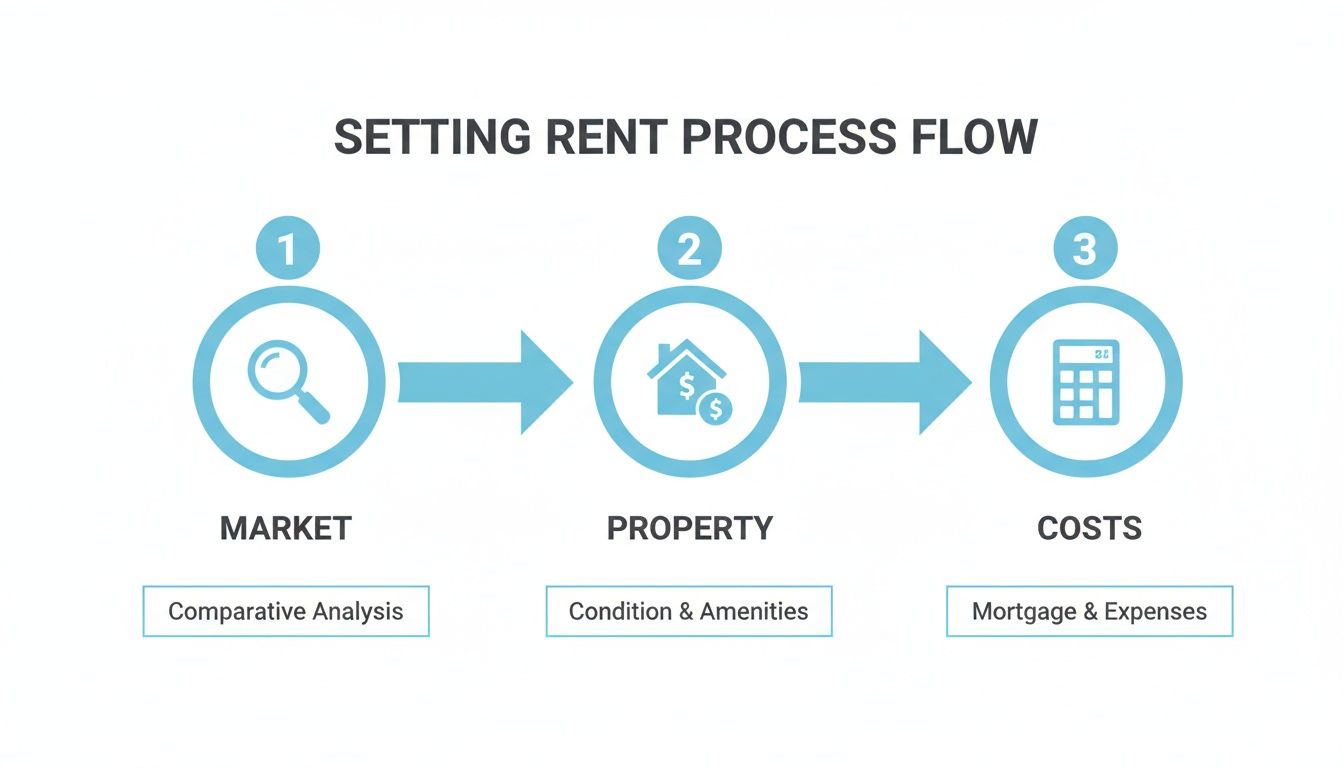
This simple flow shows how these three elements work together. You start with the market, factor in your property's unique features, and underpin it all with your costs.
Before diving deep, it's helpful to have a simple framework. This checklist breaks down the core components of setting your rent.
Quick Rent Calculation Checklist
| Factor | What to Consider | Where to Find Information |
|---|---|---|
| Market Research | Current rental prices for similar properties in your immediate area (postcode, street). Look at size, condition, and number of bedrooms. | Rightmove, Zoopla, OpenRent (check their "recently let" sections), local letting agents. |
| Property Value | Special features: recent renovations, garden, parking, en-suite bathrooms, high-speed internet, proximity to transport/amenities. | Your own property assessment, comparing features against other local listings. |
| Cost & Profit | All expenses: mortgage, insurance, maintenance fund (at least 10% of rent), letting fees, service charges, licensing costs, and desired profit margin. | Mortgage statements, insurance quotes, your own business plan and calculations. |
Using this table ensures you've covered the fundamentals before getting into the finer details of your calculation.
While national statistics are interesting, they should only be used as a backdrop. For instance, the latest ONS data shows the average UK private rent was £1,368 per month as of December 2025. But that figure hides a massive regional divide, from £1,424 in England to just £822 in Wales. This is exactly why your own local analysis is what truly matters. You can always explore more about these UK rental market trends to see the bigger picture, but your focus should always be local.
Conducting Hyper-Local Market Research
Forget national averages. The real answer to "how much rent can I charge?" is found right on your doorstep. Rent is set street by street, not by a government report. To land on a competitive price, you need to become a local expert, digging into what tenants are actually willing to pay for a property just like yours, right now.
This means you’re not just looking for any old rental; you're hunting for direct comparables. These are properties that closely mirror yours in the key aspects that tenants genuinely care about.

Finding Your Direct Comparables
Your first port of call should be the major property portals. Don't just browse casually; get a spreadsheet open and start tracking properties that are a close match to yours.
- Property Type and Size: If you have a 3-bed terrace, you need to be comparing it with other 3-bed terraces, not detached houses down the road. Same goes for rooms – look for other rooms in shared houses.
- Location: Narrow your search down to your specific postcode, and if you can, the immediate surrounding streets. Being a short walk from a popular park or, conversely, next door to a noisy pub, can make a huge difference to the price.
- Condition: Now, be honest with yourself about your property's condition. Is it newly refurbished with a slick, modern kitchen, or is it looking a bit tired? Find listings that reflect a similar standard of finish.
Once you’ve got a solid list of five to ten comparable properties, you can start to build an evidence-based picture of the current market rate in your specific pocket of town. You can begin your search for comparable rooms to let right now to see what other landlords are currently charging.
Analysing the Finer Details
Looking beyond the headline price is where you gain a real edge. You need to read between the lines of each listing to understand the true value being offered.
Start asking some critical questions about each comparable you find:
- What’s actually included? Is the rent 'all-inclusive' of bills, or will tenants have to cough up for council tax, gas, and electricity on top? This can easily add £100-£200 to a tenant's monthly outgoings.
- Are there any incentives? Is the landlord offering the first week rent-free or a reduced deposit? This is often a signal that the property has been lingering on the market for a while and might be slightly overpriced.
- How long has it been listed? A property that has been advertised for over a month is a major red flag. It strongly suggests the asking price is just too high for the local market.
A key part of your research is understanding the story behind the price. A freshly listed, high-quality property that gets snapped up in days is a far better indicator of market value than a tired-looking one that’s been sitting empty for weeks.
Accounting for Local Demand Drivers
Finally, don't forget to consider the unique factors that drive demand in your specific neighbourhood. These little micro-influences can absolutely justify a higher rental price.
Things like being close to a train station or tube stop, a large local employer like a hospital or university, or being in the catchment area for a top-rated school all crank up demand.
Timing your listing can also be crucial. Recent analysis has shown just how seasonal the rental market can be. For example, average rents in England peaked in July 2025 at £1,496, but by December they had fallen 19% to £1,214. This just goes to show how much tenant demand fluctuates throughout the year, impacting what you can realistically charge. You can review more on these monthly rental fluctuations on Landlord Knowledge.
Calculating Your True Costs and Profit Margin
Knowing the going rate for similar properties in your area is a great start, but it's only half the story. To figure out how much rent you can charge and actually make a decent return, you have to get brutally honest about your outgoings.
A profitable rental isn’t measured by the rent coming in; it's measured by what’s left in your bank account after every single cost has been paid. This means digging a lot deeper than just your mortgage payment. I’ve seen too many landlords fall into the trap of only factoring in their mortgage and maybe the council tax, which leads to a nasty shock when they realise their ‘profit’ is barely covering the bills.

Identifying Your Monthly Outgoings
Let’s get granular and break down all the potential costs you need to build into your sums. Some of these hit your account every month, while others are annual bills you should spread out to find a true monthly cost.
Here's what you need to account for:
- Mortgage Payments: The big one, your largest and most obvious expense.
- Landlord Insurance: Absolutely non-negotiable. This covers the building, any contents you provide, and your liability.
- Council Tax & Utilities: If you're going down the 'all-inclusive' route, you have to accurately budget for gas, electricity, water, and broadband. Underestimate these, and your profit vanishes.
- Service Charges or Ground Rent: A regular cost if your property is a leasehold, like most flats.
- Letting Agent Fees: Whether it's a 'tenant-find' service or full management, this is usually a percentage of the monthly rent.
- Safety Certificates: The annual gas safety check (CP12) is a legal must, as is an Electrical Installation Condition Report (EICR) every five years. These aren't free.
To really nail down your numbers, you have to think about ongoing upkeep. A detailed rental property maintenance checklist is a fantastic tool for tracking these smaller, recurring expenses. Staying on top of maintenance doesn't just keep tenants happy; it protects the value of your asset and justifies the rent you're charging.
To help you get a handle on this, I've put together a simple calculator to map out your expenses.
Landlord Monthly Expense Calculator
This table gives you a framework for tallying up every potential cost, helping you find your breakeven point and set a rental price that actually delivers a profit.
| Expense Category | Estimated Monthly Cost (£) | Notes |
|---|---|---|
| Mortgage Payment | The main monthly outgoing for most landlords. | |
| Landlord Insurance | Divide your annual premium by 12. | |
| Council Tax (if applicable) | Only if you pay it (e.g., HMOs, voids). | |
| Utilities (if bills included) | Gas, electricity, water, broadband. Be generous. | |
| Ground Rent / Service Charge | For leasehold properties. | |
| Letting Agent Fees | e.g., 10% of monthly rent. | |
| Gas Safety Certificate (CP12) | Annual cost divided by 12. | |
| EICR | Cost spread over 60 months (5 years). | |
| Maintenance & Repairs Fund | Aim for 5-10% of rent. | |
| Void Period Buffer | e.g., 1 month's rent divided by 12. | |
| Other (e.g., cleaning) | Any other regular service costs. | |
| TOTAL MONTHLY COSTS | Your breakeven figure. |
Once you’ve filled this in, you have a powerful number: the absolute minimum you need to charge just to cover your costs. Anything above this is your potential profit.
Budgeting for the Unpredictable
The landlords who stay in the game long-term are the ones who plan for things to go wrong. Two huge costs can completely wreck your finances if you're not prepared: surprise repairs and void periods (when the property is sitting empty between tenants).
A solid rule of thumb is to siphon off at least 10% of your monthly rental income into a separate contingency fund. This pot of money is purely for emergencies and to cover the mortgage if you have a month with no tenant.
This isn’t about being pessimistic; it's just smart business. A boiler on the blink or a leak in the roof can easily run into thousands. Having that cash ready means you can sort it out fast, keeping your tenants happy and your investment secure without having to dip into your personal savings.
Calculating Your Yield and Profit Margin
With a grand total for your monthly expenses in hand, you can finally work out how profitable your property really is.
First, there’s your gross yield. This is a quick, back-of-the-envelope way to compare different property investments. Just take your total annual rent, divide it by the property's purchase price, and multiply by 100. For instance, a property bought for £200,000 that brings in £12,000 in rent a year has a gross yield of 6%.
But the number that truly matters is your net profit. This is your real-world return after every single cost has been deducted.
Here's the simple calculation:
(Total Annual Rent) - (Total Annual Expenses) = Annual Net Profit
This final figure is the ultimate acid test. It tells you exactly how hard your investment is working for you and gives you the confidence that the rent you're asking for is enough to hit your financial goals.
Navigating Legal and Licensing Requirements
Setting the right rent isn't just about spreadsheets and market research; you've got to stay on the right side of the law, too. The legal landscape for UK landlords can feel a bit dense at times, but getting to grips with your obligations is absolutely critical. Ignoring them isn't just about risking a fine—it could make your tenancy agreements worthless and your rental income unlawful.
One of the biggest legal hurdles, especially if you're renting out individual rooms, is HMO licensing. It’s a term you’ll hear a lot. A property is classed as a House in Multiple Occupation (HMO) if at least three tenants live there, forming more than one household, and they share a toilet, bathroom, or kitchen.
Understanding HMO Licensing
If your property is a ‘large HMO’ – that means it houses five or more tenants from more than one household – then a mandatory HMO licence from your local council is non-negotiable.
But it doesn't stop there. Many councils have also brought in additional licensing schemes that apply to smaller HMOs, sometimes catching properties with just three tenants sharing. You have to check your specific local authority's rules.
These licences are more than just a bit of paperwork. They come with strict conditions that can directly impact how much rent you can realistically charge. Councils have the power to enforce rules on:
- Minimum room sizes for bedrooms.
- The number of bathrooms or kitchens needed per tenant.
- Fire safety measures, like networked smoke alarms and proper fire doors.
Suddenly, that small box room you planned to let out might not meet the minimum size requirement, meaning it can't legally be rented at all. That instantly cuts your property's potential income. Making sure your property is up to scratch, including having up-to-date electrical safety checks, is part of the cost of doing business legally.
Fees, Deposits, and Lodgers
Beyond licensing, other laws dictate what you can and can't charge. The Tenant Fees Act 2019 put a stop to many of the extra charges landlords used to pass on. Now, you can only ask tenants to pay for rent, a tenancy deposit (capped at five weeks' rent), a holding deposit (capped at one week's rent), and a few specific default fees. Charging for referencing, admin, or inventories is now illegal.
What’s more, any deposit you take must be protected in one of the three government-approved tenancy deposit schemes within 30 days of you receiving the money. If you fail to do this, you could be ordered to pay the tenant up to three times the deposit amount in compensation. It’s a costly mistake to make.
Homeowners with a lodger have a slightly different set of rules to play by. The Rent a Room Scheme is a fantastic incentive, allowing you to earn up to £7,500 tax-free each year from letting out a furnished room in your own home. This is a significant tax break that can make having a lodger a very attractive financial move.
At the end of the day, a legally compliant property is a profitable one. When you factor in the costs of licensing, any necessary safety upgrades, and follow the rules on deposits, you ensure the rent you set is not only competitive but sustainable and, most importantly, lawful.
Setting Prices for Different Room Types
When you're running a shared property, a one-price-fits-all approach just doesn't cut it. It's a rookie mistake. To get the best possible income from your property and keep all your tenants happy, you need a smart pricing structure that reflects what each room is actually worth.
Let's be honest, not all rooms are created equal, and you can bet your tenants will notice. A spacious master bedroom is always going to be worth more than a small single, but the differences go much deeper than just square footage. You need to build a clear tier system based on the specific perks each room offers. This isn't just about making more money; it’s about being able to justify your prices and attract good, long-term tenants.
Valuing Room-Specific Features
Start thinking of your property as a collection of individual products. Each room has its own unique selling points, and your job is to put a value on them to figure out a fair premium.
Here are the key things I always look at when creating pricing tiers:
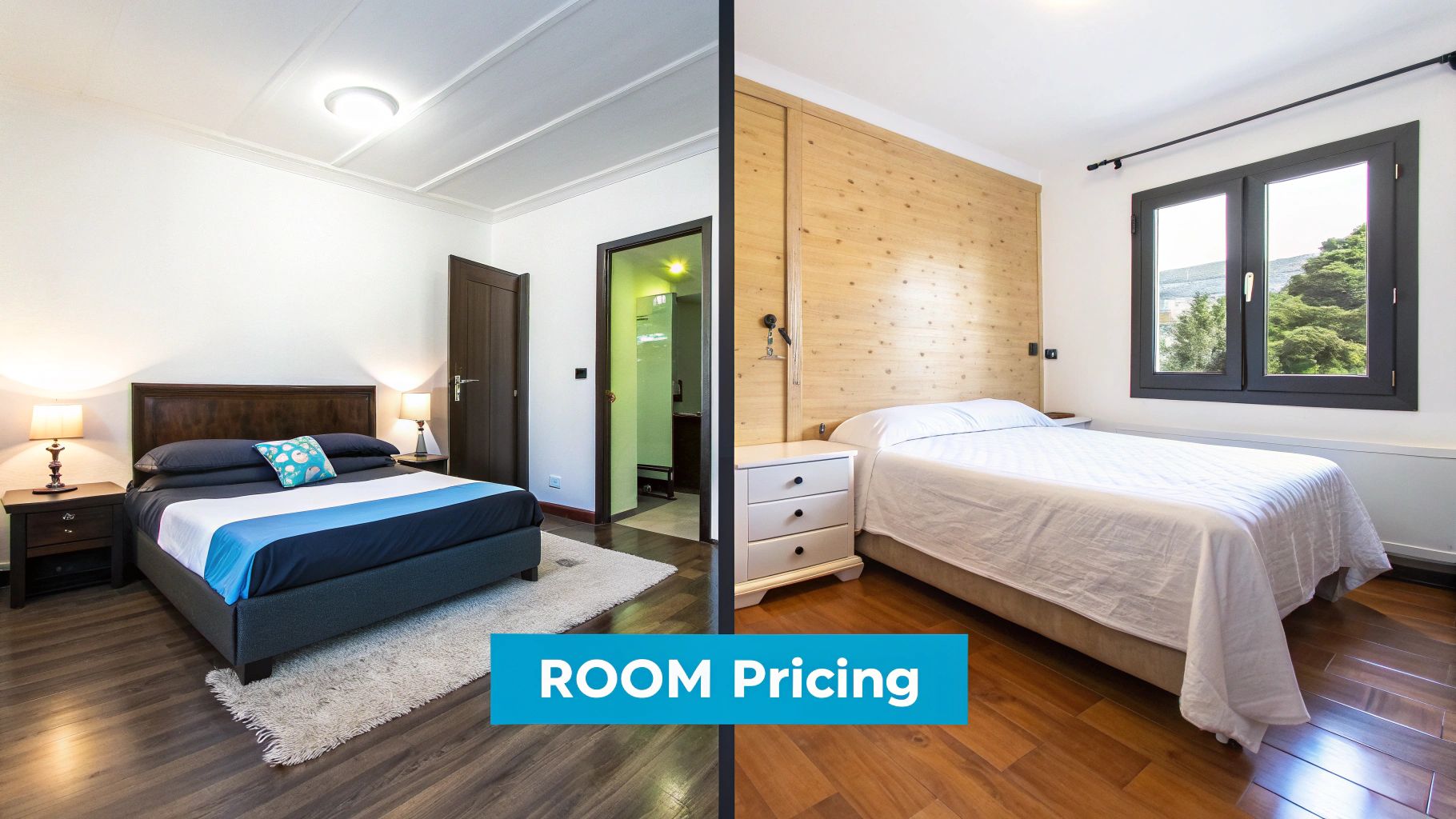
- En-suite Facilities: This is the big one. An en-suite bathroom is the single greatest value-add you can have. A room with its own private bathroom can easily fetch a 15-25% premium over a similar-sized room that has to share. That privacy and convenience is something tenants will consistently pay more for, every single time.
- Room Size and Layout: Don't just think 'double' or 'single'. Look at the usable space. Is the room a bit of an awkward shape, or does it have a nice, practical layout with obvious space for a desk and other furniture? A well-proportioned room feels bigger and more valuable.
- Storage Space: Never underestimate the power of good storage. A room with a large built-in wardrobe is a huge win for a tenant compared to one where they have to buy their own. It’s a simple feature that adds real, tangible value.
- Location Within the House: The room's position in the property matters more than you’d think. The quiet room at the back overlooking the garden is far more desirable than the one at the front facing a noisy road. Similarly, some tenants feel less secure in a ground-floor room, making it slightly less appealing.
I find it helps to create a simple checklist. Assign a value to each of these features to build a transparent pricing model. The large, quiet, en-suite room becomes your top-tier price, and you just work your way down, knocking a bit off for each feature a room is missing.
All-Inclusive vs Bills-Exclusive Rent
Finally, you need to decide on your pricing strategy: are you including bills or not?
Offering an 'all-inclusive' rent is incredibly popular with tenants in the UK. One simple monthly payment that covers everything—council tax, gas, electricity, broadband—gives them certainty over their budget. It's a massive selling point. Yes, it puts the admin burden of managing the bills onto you, but it almost always allows you to charge a bit of a premium for that convenience.
The alternative is a 'bills-exclusive' model, where tenants have to sort out and split the utilities themselves. This can be a turn-off for many, especially young professionals who are looking for a hassle-free living arrangement. When you're working out how much rent you can charge, remember that the simplicity of an all-inclusive package can give you a serious competitive edge and justify a higher overall income.
Marketing and Negotiating Your Rental Price
You’ve done the sums and landed on a solid rental price. Now for the final piece of the puzzle: marketing your property effectively and handling any negotiations with confidence. This is where all that research you did really comes into its own, allowing you to clearly justify the value of your room and attract the high-quality tenants you're looking for.
A compelling rental listing is your most powerful marketing tool. It’s not just about stating the price; it’s about selling the lifestyle and proving the value behind the number. Think of your description as a highlight reel of the property’s best features.
Crafting a Winning Listing
Your advert needs to sell the experience of living there, not just the physical space. Use punchy, benefit-driven language to draw potential tenants in.
- Highlight Key Upgrades: Have you recently fitted a new kitchen, installed a high-efficiency boiler, or upgraded to fibre broadband? These are tangible benefits that justify a higher price point, so make sure you mention them.
- Emphasise Location Perks: Talk about the things that make the area great. Is it a five-minute walk to the station? Are there popular cafes, a lovely park, or a great local pub just around the corner?
- Use High-Quality Photos: This is non-negotiable. Bright, clear, and well-staged photos are essential. Dark, blurry pictures will instantly devalue your property in a potential tenant’s eyes, no matter how nice it is in person.
Your goal is to create a listing that answers the question, "Why is this room worth the price?" before a tenant even has to ask. Showcasing the value upfront helps filter out casual browsers and attracts serious applicants who appreciate quality.
When you're ready to list, explore different platforms to get your room seen by the widest possible audience. You can take a look at our advert prices and options to find a package that works for you.
Preparing for Negotiation
Even with a perfectly priced room, you should always be prepared for a bit of haggling. It’s a smart move to price your room with a small buffer, maybe £25-£50 higher than your absolute minimum. This gives you a little wiggle room to negotiate without eating into your bottom line.
If a prospective tenant does make a lower offer, don’t take it personally. Respond confidently by gently reiterating the property's key benefits. You can remind them of the all-inclusive bills, the recent decoration, or the fantastic location that makes life easier.
Looking ahead, the dynamics in the UK rental market are very much leaning in landlords' favour. With rental stock expected to shrink through 2025, demand is forecast to stay strong well into 2026, which will naturally support rent prices. This trend should give you the confidence to hold firm on a fair price for a well-maintained, desirable property.
By confidently articulating your property’s value, you can secure a great tenancy quickly, minimise those costly void periods, and turn all your careful planning into real, tangible income.
Your Questions Answered: Common Queries on Setting Rent
Whether you're a seasoned landlord or just starting, a few common questions always pop up when it comes to setting the right rent. Getting these details right from the start makes for a much smoother, more profitable tenancy down the line.
How Often Can I Review the Rent?
In the UK, the general rule of thumb is that you can only increase the rent once every 12 months for most tenancies. It’s crucial that any increase is fair and realistic, keeping it in step with the going rate for similar properties in your local area.
If you have a fixed-term tenancy, you can only put the rent up if your tenant agrees to it or if you’ve included a specific 'rent review clause' in the original tenancy agreement. For periodic or 'rolling' tenancies, the process is more formal. You need to provide at least one month's notice using an official Section 13 notice.
Should I Allow Pets in My Property?
Ah, the great pet debate. Deciding whether to allow pets can feel like a tricky balancing act. On one hand, you open your property up to a much wider pool of responsible, long-term tenants. On the other, there's always the risk of a little extra wear and tear.
It's worth knowing that under the Tenant Fees Act 2019, you can't charge a higher tenancy deposit just for a pet. What you can do, however, is agree to a slightly higher monthly rent to account for the potential for extra scuffs or cleaning. This is a common and perfectly legal way to make your property pet-friendly while still protecting your investment.
For more practical advice on navigating the world of lettings, feel free to explore our extensive blog for landlords and tenants.
At Rooms For Let, we make finding the right tenant straightforward. Advertise your room with us and connect with thousands of people searching for their next home. Find your ideal tenant today at https://www.roomsforlet.co.uk.