A Section 13 notice is the official, legally required way for a landlord in the UK to increase the rent on a property once the tenancy becomes ‘periodic’ – in other words, when it rolls into a month-by-month arrangement. It’s a specific process laid out under the Housing Act 1988, and it’s designed to make sure any rent adjustments are proposed formally and with the correct notice period, which is typically at least one month.
Understanding the Purpose of a Section 13 Notice

Think of a Section 13 notice as the only formal tool you have for updating the rent once a fixed-term contract has ended and your tenancy is just rolling along. It’s the official mechanism that takes the place of informal chats or emails about rent changes, giving both you and your tenant a clear, documented paper trail.
Using this notice is non-negotiable in certain situations. The most common scenario is when your original tenancy agreement doesn't include a specific ‘rent review clause’. Without that clause spelling out how and when rent can be increased, you can't just decide to raise it; you absolutely must follow the statutory procedure laid out by Section 13.
When Is This Notice Required?
So, when do you actually need to reach for a Section 13 notice? Its main job is to create a legally binding rent increase when you can't just agree on a new figure informally, or when you want to keep everything strictly by the book. It’s specifically designed for assured shorthold tenancies that have moved past their initial fixed term and are now periodic.
A few key conditions have to be met:
- The tenancy must be periodic. You can't use this notice during a fixed-term agreement unless the tenant willingly agrees to sign a completely new contract.
- No rent review clause exists. If your tenancy agreement already has a process for increasing rent, you have to follow that instead.
- It can only be used once every 12 months. You can’t issue multiple rent increases within a single year using this method.
To help clarify, here’s a quick-glance table to help you decide if a Section 13 notice is the right tool for your situation.
When a Section 13 Notice Is the Right Tool
| Scenario | Can You Use Section 13? | Reason |
|---|---|---|
| Tenant's 12-month fixed term has expired and they are now on a monthly rolling contract. | Yes | The tenancy is periodic, which is the primary condition for a Section 13 notice. |
| Tenant is only 6 months into a 12-month fixed-term contract. | No | The notice cannot be used during a fixed term. The agreed rent is locked in. |
| The tenancy agreement contains a clause stating "rent will increase by 3% each year". | No | You must follow the procedure outlined in the rent review clause. |
| You increased the rent using a Section 13 notice just 8 months ago. | No | A Section 13 notice can only be served once every 12 months. |
This table should make it clear that the notice is for a very specific set of circumstances, and getting it wrong can invalidate your proposed rent increase.
Starting on Solid Legal Ground
Understanding whether a Section 13 notice is the right move is the first, crucial step in managing your property professionally. Using it correctly ensures you operate within the law, protecting you from potential disputes and giving your tenant a clear, official notification of the proposed change. It’s all about starting the rent review process on solid legal ground.
For landlords looking to broaden their knowledge beyond just rent increases, exploring additional landlord resources can provide valuable insights into every aspect of property management.
Meeting the Legal Requirements for a Valid Notice

Issuing a Section 13 notice isn't like sending a casual email; it’s a formal legal process where every detail counts. Think of it like assembling flat-pack furniture – miss a single screw or get a panel the wrong way around, and the whole thing is wobbly and useless. A small mistake on the notice can make it completely invalid, sending you right back to square one.
The absolute foundation of a valid notice is using the right paperwork. This is the official Form 4, and you must download a fresh copy from the GOV.UK website every single time you issue one. Don't be tempted to use an old version you've saved on your computer or a template you've found elsewhere. Forms get updated, and using an outdated one is a surefire way to get it wrong.
Deconstructing the Official Form 4
At first glance, Form 4 can look a bit dense and full of formal jargon. But if you break it down, it's just a logical sequence of boxes designed to capture all the legally necessary information. Getting every single one of these right is non-negotiable.
Here are the key parts you absolutely have to get perfect:
- Landlord and Tenant Details: This sounds obvious, but it’s a common tripwire. You need to list the full names of all tenants, exactly as they appear on the tenancy agreement. Your own name and address must also be complete and correct.
- Property Address: State the full, unambiguous address of the rental property the notice applies to.
- Proposed New Rent: Clearly state the new rent amount and how often it's paid (e.g., £950 per calendar month). Any vagueness here will kill your notice.
- Start Date for the New Rent: This is where most landlords fall down. The date you put here has to be the first day of a tenancy period and must give the tenant at least the minimum legal notice.
Crucially, this isn't just a letter. The official Form 4, complete with all its statutory notes, must be served to each tenant named on the agreement. Getting this formality right is your best defence if a dispute arises, which is more important than ever as possession claims have seen a significant rebound in recent years.
Calculating the Correct Notice Period and Start Date
The law is incredibly specific about the timing. For most tenancies where rent is paid monthly, you must give at least one full month's notice. If rent is paid weekly, it's one week's notice. For very rare yearly tenancies, it's a full six months.
But here’s the golden rule that catches so many people out: the rent increase can only start on the first day of a rental period. This isn't always the first of the month or the day the rent is paid. It’s tied to the day the original tenancy began.
Example Scenario: Getting the Date Right
Let's walk through a common situation.
- A tenancy agreement started on the 5th of March. Rent is paid monthly.
- This means the rental periods run from the 5th of one month to the 4th of the next.
- You decide to serve the notice on the 20th of June.
- To give one full month's notice that aligns with the rental period, the earliest the new rent can start is the 5th of August. Choosing the 5th of July wouldn't work because the tenant wouldn't have had a clear rental period of notice.
Failing to line up the start date with the tenancy period is a classic, costly error. It's a small detail with huge consequences, as it instantly voids the notice. Before you even think about filling in Form 4, dig out the original tenancy agreement and confirm the exact start date. That one simple check will save you months of delay and lost income.
How to Properly Serve the Notice to Your Tenants

Creating a legally perfect Section 13 notice is only half the battle. If you don't deliver it to your tenant correctly, it holds absolutely no legal weight. This formal act of delivery is called 'serving', and getting this step right is every bit as critical as filling out the form itself.
Think of it like a recorded delivery that needs a signature; the process of getting it there is what validates the contents. Fortunately, the law provides a few straightforward and accepted methods, meaning you can get this done efficiently and, most importantly, legally.
Your main goal isn't just to hand over a piece of paper. It's to create a clear, undeniable record that you did so. This proof of service is your safety net if a tenant later claims they never received the notice, a single claim that can derail the entire rent increase.
Acceptable Methods of Service
The method you pick for serving the notice should be practical, of course, but it must be legally recognised. Each approach has its own way of generating that all-important proof, so choose the one that gives you the most confidence.
There are three main ways to serve a Section 13 notice:
- Personal Delivery: Simply handing the notice directly to the tenant. This is often the most direct route if you have a good relationship and see them regularly.
- Leaving at the Property: Posting the notice through the letterbox of the rental property. A very common and effective method, especially if you live nearby.
- Postal Service: Sending the notice by post. While you can use standard post, using a tracked service is strongly recommended to create a reliable paper trail.
No matter which method you use, the crucial element is proof. A simple claim that you "dropped it off" probably won't be enough if you're challenged. You need to gather solid evidence that shows exactly when and how the notice was served.
Creating Undeniable Proof of Service
Your evidence is what turns the simple act of delivery into a legally robust action. Without it, you’re left vulnerable to disputes that can invalidate your notice and force you to start the whole process all over again.
Here’s how to generate strong evidence for each method:
- For Personal Delivery: The best approach is to bring a witness with you. After handing the notice to the tenant, you and your witness should immediately sign and date a short statement confirming the time, date, and location of the service. A signed witness statement is powerful stuff.
- For Leaving at the Property: This is where your smartphone becomes your best friend. Take a clear, timestamped photo showing the notice partway through the letterbox, making sure the property's front door or number is visible in the shot. This creates a brilliant visual record.
- For Postal Service: Always, always opt for a service that gives you proof of delivery. Royal Mail Signed For (First Class) is a great option, providing you with a receipt, a tracking number, and confirmation once it’s been delivered. Keep that receipt somewhere safe!
Special Considerations for HMOs
If you manage a House in Multiple Occupation (HMO) where your tenants are on separate tenancy agreements, you absolutely must serve an individual Section 13 notice for each tenancy. You can't just issue a single, collective notice for the whole house.
Each tenant is on their own legal agreement and must be notified formally and individually. For specific advice on complex HMO situations, it can be a huge help to get in touch with property letting experts for professional guidance.
What Happens After You've Served a Section 13 Notice?
Serving a Section 13 notice isn’t the final word; it’s the start of a conversation. Once that notice is in your tenant’s hands, what happens next is entirely up to them. Being ready for every possible reaction is the key to managing the process professionally, protecting your investment while respecting your legal duties.
Think of this period as a crucial waiting game. The ball is now in your tenant's court, and their decision determines whether the rent increase goes through smoothly, needs a bit of negotiation, or ends up being formally challenged.
The Three Ways a Tenant Might Respond
After receiving the notice, your tenant will usually go down one of three paths. Each requires a different approach from you, so understanding them upfront will help you handle things calmly and correctly.
Here’s what you can generally expect:
- Acceptance: The tenant agrees to the new rent. This might be confirmed in a message, or they might simply start paying the higher amount on the specified date. Simple.
- Negotiation: The tenant gets in touch to discuss the increase. They might feel it's a bit steep and want to see if you can agree on a middle ground.
- Challenge: The tenant decides to formally dispute the increase by applying to the First-tier Tribunal (Property Chamber). They must do this before the new rent is due to start.
It’s essential to keep meticulous records during this time. Log every conversation and keep a close eye on rent payments once the notice period ends. Your tenant's actions (or lack thereof) will make their position crystal clear.
Tenant Responses and Landlord Actions
To make it easier, here’s a quick summary of how to interpret and react to your tenant's response.
| Tenant Response | What It Means | Recommended Landlord Action |
|---|---|---|
| Pays the new rent | This is considered "implied acceptance." By paying, they've legally agreed to the new terms. | No action needed. Just ensure your records reflect the new rent amount and issue updated rent statements. |
| Contacts you to negotiate | The tenant is open to an increase but thinks your proposal is too high. | Be open to a discussion. Listen to their reasoning and present your market evidence. If you agree on a new figure, put it in writing. |
| Formally challenges the notice | The tenant has applied to the First-tier Tribunal to have a fair market rent determined independently. | Cooperate fully with the tribunal process. Gather all your evidence (comparable local properties, improvements made) to justify your proposed rent. |
| Continues to pay the old rent | They are ignoring the notice. This is not a formal challenge but will lead to rent arrears. | Send a polite but firm reminder that a legal notice has taken effect and state the shortfall. If they persist, follow your standard rent arrears procedure. |
| Gives notice to leave | The rent increase has prompted them to end their tenancy (assuming they are outside a fixed term). | Acknowledge their notice and begin the standard end-of-tenancy process (check-out, deposit return, etc.). |
Remember, clear communication and good record-keeping are your best tools, no matter which path the tenant chooses.
What is the First-tier Tribunal?
The phrase "tribunal" can sound daunting, but it’s actually a very straightforward process. If a tenant challenges your Section 13 notice, the First-tier Tribunal simply acts as an independent referee. Their job isn’t to punish anyone; it’s to decide what a fair market rent for your property should be.
A tribunal will look at what rent your property could realistically get if it was put on the open market today, with the same tenancy terms. This is a crucial point: the outcome isn't a guaranteed win for either side.
The tribunal's decision can go one of three ways:
- They agree with you: Your proposed rent is upheld because it reflects the current market value.
- They set a lower rent: They decide your proposal was too high compared to similar properties.
- They set a higher rent: In some cases, they might find your property is actually worth more than you asked for.
This process has become more relevant than ever, especially as UK private rents have seen record growth. Recent data from the ONS highlighted a staggering 8.6% rise in the year to July, a huge jump from 4.7% the year before. This is driving the need for rent adjustments in competitive areas. For landlords using platforms like Rooms For Let, being able to justify a rent increase with solid, local market comparisons is absolutely vital, as tribunals rely on this kind of evidence to set a 'fair rent'. You can find more insights on market trends over at Total Landlord Insurance.
What if the Tenant Just Pays the Old Rent?
So, the start date for the new rent comes and goes, but your tenant ignores the notice and pays the old amount. What now? This is a partial payment, and if it continues, it will build up into rent arrears.
Your first move should always be clear communication. Send a polite but formal letter or email. Remind them that the legally served Section 13 notice is now in effect and clearly state the shortfall.
If they keep underpaying, the debt simply becomes standard rent arrears. From there, you just follow the established legal path for rent recovery. This could eventually lead to eviction proceedings under a Section 8 notice if the arrears hit a significant level, which is typically two months' worth of rent.
Common Mistakes Landlords Make and How to Avoid Them
Learning from other people’s mistakes is always the quickest way to get things right. When it comes to a Section 13 notice, even a tiny slip-up can invalidate the entire process, costing you time, money, and putting a serious strain on your relationship with your tenant.
Think of it like following a map through a legal maze. The route is clearly marked, but if you take one wrong turn, you’re right back at the start. Thankfully, the most common errors are often the simplest ones to sidestep with a bit of care.
These blunders can be anything from using an old bit of paperwork to a simple typo when calculating dates. The result is always the same: a void notice and a delay in getting the fair rent you’re entitled to.
Using Outdated or Incorrect Forms
One of the most frequent – and easily avoidable – mistakes is using the wrong form. The only document that counts is the official Form 4, and it absolutely must be the latest version from the GOV.UK website. Any landlord relying on an old file saved on their computer or a random template they’ve found online is taking a huge risk.
The government updates these forms now and then to keep up with changes in the law. Using an old version is an instant fail, no matter how perfectly you’ve filled it in. Make it a rule: always download a fresh copy every single time you issue a notice.
Miscalculating Dates and Notice Periods
Timing is everything with a Section 13, and this is where so many landlords trip up. You have two crucial dates to get spot on: the notice period and the date the new rent actually begins. For a standard monthly tenancy, you must give at least one full month’s notice.
But here's the critical part: the new rent can only start on the first day of a rental period. This is dictated by the day the original tenancy began, which isn’t always the same day the rent is paid each month.
Example of a Costly Timing Mistake: Let’s say a tenancy started on the 10th of the month. The rental periods, therefore, run from the 10th to the 9th of the following month. The landlord serves a notice on May 15th, proposing the new rent starts on July 1st. This notice is completely invalid. Why? Because July 1st is not the start of a rental period. The correct start date would have been July 10th.
A single wrong date makes all your effort worthless. It just goes to show how vital it is to dig out that original tenancy agreement and confirm the exact start date before you even think about filling out the form.
Proposing an Unrealistic Rent Increase
While there’s no legal cap on rent increases in England, proposing a figure that’s wildly out of step with the local market is a bad move. If your tenant thinks the increase is unreasonable, they can challenge it at a First-tier Tribunal, and an excessive figure makes their case much stronger.
A tribunal isn’t there to rubber-stamp your proposal. Its job is to determine a fair market rent for the property. If they decide your figure is too high, they have the power to set a lower rent, or even rule that it shouldn’t change at all.
The best way to avoid this is to do your homework. Before you decide on a number, research what similar properties in your area are renting for. Having solid evidence to back up your proposed rent makes a successful challenge far less likely.
Simple Dos and Don'ts Checklist
To help you stay on the right track, run through this quick checklist before you serve your notice.
- DO download the latest Form 4 directly from the GOV.UK website.
- DON'T use an old, saved version or a template from another website.
- DO dig out the original tenancy agreement to find the exact start date.
- DON'T just guess the start date or assume it’s the same day rent is due.
- DO research local market rents to set a fair and justifiable increase.
- DON'T pluck a high figure out of thin air that’s easy to challenge.
- DO make sure you have undeniable proof that you served the notice correctly.
- DON'T just pop it through the letterbox without a witness or photo evidence.
Your Essential Section 13 Notice Checklist
Let's pull everything together. Before you even think about serving a notice, running through a final checklist is the smartest thing you can do to make sure every detail is legally sound.
Getting into a methodical habit here is crucial. It drastically cuts the risk of simple mistakes that could make your notice invalid, protecting your rental income and keeping things professional with your tenant. Think of this as your final once-over before hitting 'go'.
Pre-Notice Preparations
Before you even download the form, you need to get the basics right. A mistake at this early stage will completely undermine the whole process.
- Confirm Tenancy Type: Is the tenancy an assured shorthold tenancy that has rolled over into a periodic one (like a month-to-month contract)? Remember, you absolutely cannot use a Section 13 notice during a fixed term.
- Check the Tenancy Agreement: Take a look at the original agreement. Does it already have a rent review clause in it? If it does, you have to follow that process instead of using a Section 13.
- Verify the Last Increase: Has it been at least 12 months since the last time you increased the rent using a Section 13 notice? You can only use this official route once a year.
- Research Market Rent: Have you done your homework? Look at what similar local properties are renting for to make sure your proposed new rent is fair and you can justify it if challenged.
Drafting and Serving the Notice
This is where accuracy is everything. Tiny errors in dates or details are the number one reason these notices get thrown out.
- Download the Correct Form: Always, always get the latest version of Form 4 straight from the GOV.UK website. Don't be tempted to use an old copy you have saved somewhere.
- Calculate Dates Carefully: You need to pinpoint the exact start date of the tenancy period. The new rent must begin on the first day of a period, not halfway through. For a monthly tenancy, you must give at least one full month's notice.
- Complete All Sections: Fill in every box. Make sure the landlord and tenant details match what's on the tenancy agreement perfectly.
- Serve Correctly and Prove It: Decide how you'll deliver the notice (in person, by post, or leaving it at the property) and make sure you have solid proof it was served. A witness statement or a timestamped photo of the notice in the letterbox are great options.
This infographic is a great visual reminder of the most common banana skins landlords slip on.
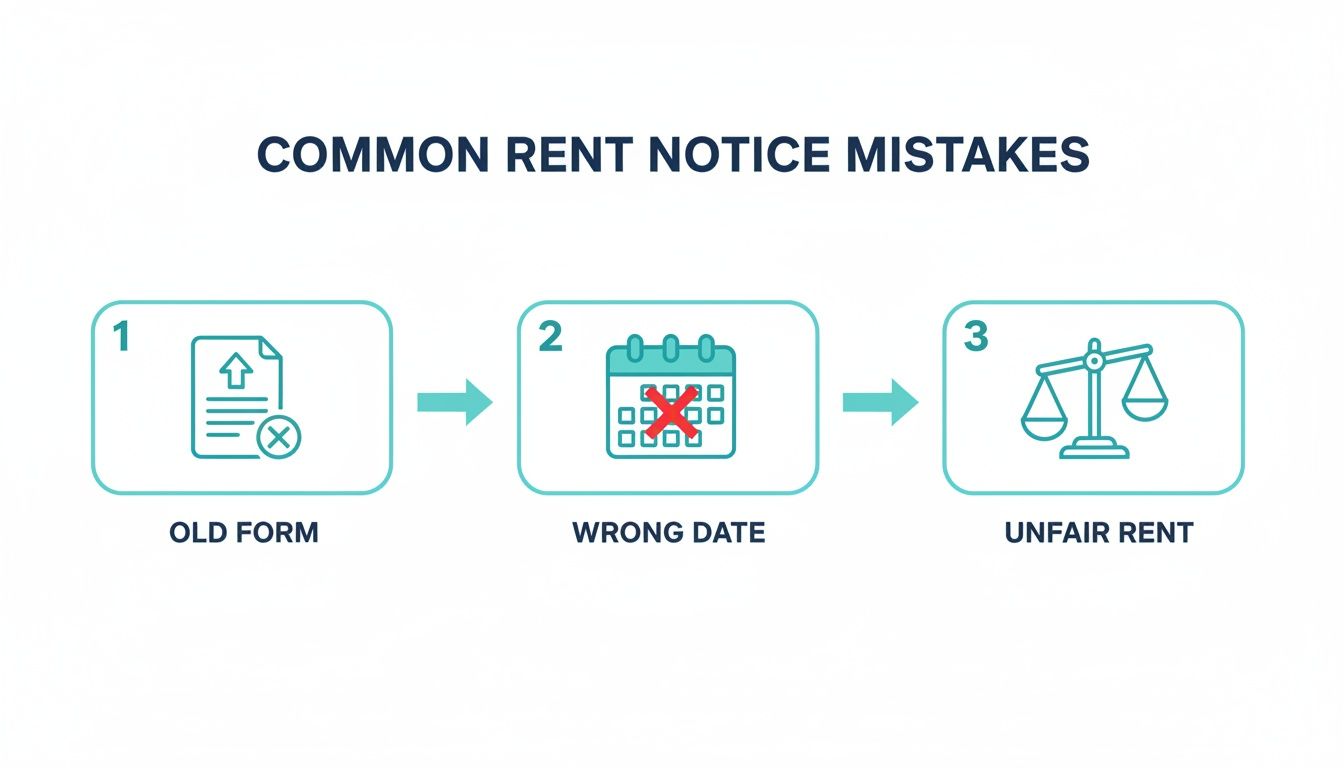
As you can see, it's the procedural stuff that catches people out—using an old form, getting the dates wrong, or plucking a new rent figure out of thin air.
Final Thoughts on Fair and Legal Practice
At the end of the day, issuing a Section 13 notice is just a standard part of managing a rental property. When you do it by the book, it's a fair and legal process that respects your rights as a landlord and the rights of your tenant.
By following the correct procedures, you can manage your rental property effectively while upholding your legal responsibilities. Fairness, clear communication, and legal compliance are key to maintaining a positive landlord-tenant relationship, even during a rent increase.
Empower yourself by being meticulous. This checklist helps you manage your property with confidence, knowing you’ve acted correctly and professionally every step of the way. For landlords looking to advertise their properties, you can explore options to register as a landlord on Rooms For Let and connect with prospective tenants.
Frequently Asked Questions About Section 13
Even when you feel you've got the hang of the process, navigating the finer points of rent increases can throw up some tricky questions. Here are the clear, straightforward answers to the queries we hear most often from landlords about using a Section 13 notice.
Can I Use a Section 13 Notice During a Fixed Term Tenancy?
In a word, no. A Section 13 notice is specifically designed for periodic tenancies – that’s the technical term for contracts that roll on a month-to-month or week-to-week basis after the initial fixed term has expired.
If your tenants are still within their fixed term, the rent is locked in by the contract they signed. The only way to increase the rent during this time is if your tenancy agreement includes a specific rent review clause, or if the tenant willingly agrees to end their current contract and sign a brand new one at the higher rent.
How Much Can I Legally Increase the Rent By?
This is a big one. In England, there’s currently no legal cap on how much you can increase the rent by in the private sector. However, that freedom comes with a very important catch: the proposed new rent must be realistic and in line with the current local market value.
If you propose an increase that’s way over the odds for similar properties in your area, your tenant has the right to challenge it. The case would go to a First-tier Tribunal, which will then determine a fair market rent – and that figure could be lower than what you proposed.
Your best strategy is always to propose a fair, evidence-based increase. Do your homework on what comparable local properties are renting for and be ready to justify your new figure. It dramatically reduces the risk of a challenge and keeps the whole process transparent and professional.
What Happens if My Tenancy Agreement Has a Rent Review Clause?
If your tenancy agreement already has a rent review clause spelling out how and when the rent can be increased, you must follow that process instead. You can’t simply choose to use a Section 13 notice in this scenario.
The clause in your original agreement takes legal priority. Trying to sidestep it with a statutory notice like Section 13 would render your proposed increase invalid. Always, always check the tenancy agreement first.
How Often Can I Serve a Section 13 Notice?
The law is very clear on this: you are only allowed to increase the rent using a Section 13 notice once every 12 months. You can't issue multiple notices within a single year to make smaller, more frequent adjustments.
To be precise, the start date for the new, higher rent must be at least 52 weeks after the last increase officially took effect. This is where good record-keeping really pays off. For more in-depth landlord advice, you can find plenty of helpful articles on our Rooms For Let blog.
Does My Tenant Have to Sign the Notice?
No, they don't. A tenant does not need to sign the Section 13 notice for it to be legally valid. Think of it as a formal notification, not a new contract that requires their signature to be activated.
Once you’ve served the notice correctly, it will automatically take effect on the date you specified. The only way to stop it is if the tenant formally challenges the increase at the First-tier Tribunal before that date arrives. If they don't challenge it and simply start paying the new amount, that’s considered "implied acceptance." If they neither challenge it nor pay the new rent, you then have a rent arrears situation to deal with.
At Rooms For Let, we make it simple and free for UK landlords to advertise their spare rooms and connect with thousands of potential tenants. Find your next tenant with us today.