At its core, a licence agreement is really just legal permission for someone to be in a property. It doesn't give them any formal legal rights over the space itself.
Think of it like getting a ticket for a hotel room. You have permission to be there for a set time, but you don't 'own' or control the room in a legal sense. A tenancy, on the other hand, gives the person a proper legal interest in the property.
Licence vs Tenancy: Understanding the Core Difference
The absolute crunch point between a licence and a tenancy comes down to one powerful legal idea: exclusive possession.
Getting your head around this single concept is the key to choosing the right agreement and staying out of serious legal trouble. Honestly, getting this wrong is one of the most common—and costly—mistakes landlords make.
And here’s the crucial bit: simply calling a document a "Licence Agreement" means nothing. If the day-to-day reality of the living arrangement gives the occupant exclusive possession, the courts will almost certainly say it's a tenancy, no matter what your paperwork calls it.
What Is Exclusive Possession?
So, what does it actually mean? Exclusive possession is the right for an occupant to exclude everyone else from their room or property—and that includes the landlord.
Imagine they can lock their door and you, as the landlord, cannot enter without their express permission (except in a genuine emergency). That's the heart of it. It’s the legal foundation of a tenancy.
A licensee, like a lodger living in your home, simply doesn't have this right. The landlord keeps control over the whole property and can enter the lodger's room as needed, perhaps for cleaning or quick maintenance checks. While giving notice is always good practice and common courtesy, you don't legally need their permission to enter.
This one difference creates a huge ripple effect on everything else:
- Security of Tenure: Tenants have hefty legal protections against eviction. Removing them usually requires a formal, and often lengthy, court process.
- Notice Periods: Licensees have far fewer rights. You can usually ask them to leave with 'reasonable notice', which is often just one rental period (e.g., one month).
- Deposit Protection: By law, landlords must protect a tenant's deposit in a government-backed scheme. This rule doesn't apply to most genuine licence agreements for lodgers.
A tenancy grants a stake in the land, creating a private space the occupant controls. A licence merely grants permission to use a space, where the landlord retains ultimate control. The label on the agreement is secondary to the reality of this control.
At the end of the day, the facts of the living arrangement are what define its legal status. That’s why it’s so vital to structure everything correctly from day one. You can find more deep dives into landlord guidance and property insights over on the Rooms for Let blog to make sure you're always on the right side of the law.
To make this even clearer, the table below breaks down these crucial differences at a glance.
Licence Agreement vs Tenancy Agreement At a Glance
This table offers a quick comparison, highlighting the core legal and practical differences you need to know.
| Feature | Licence Agreement (e.g. Lodger) | Assured Shorthold Tenancy (AST) |
|---|---|---|
| Core Concept | Permission to use a space. | A legal interest in the property. |
| Exclusive Possession | No. Landlord retains control and can enter the room. | Yes. Tenant has the right to exclude everyone, including the landlord. |
| Legal Status | Licensee. | Tenant. |
| Typical Use Case | A lodger in a resident landlord's home. | Renting a whole property or a room in a shared house (HMO). |
| Eviction Process | Simpler. Requires 'reasonable notice' with no court order needed. | Formal process, often requiring a Section 21 or Section 8 notice and court order. |
| Deposit Protection | No legal requirement to use a government scheme. | Mandatory to protect the deposit in a government-approved scheme. |
| Repairs | Landlord's general duty of care. | Specific legal repair obligations under the Landlord and Tenant Act 1985. |
As you can see, the implications of getting this wrong are significant. Choosing a licence when the situation is actually a tenancy can leave a landlord exposed and in breach of the law, particularly around deposits and eviction rights.
The Legal Test That Defines a Licence
Here’s something every landlord needs to understand: in property law, what you call an agreement doesn't matter nearly as much as how it actually works. You could write "LICENCE AGREEMENT" in giant letters at the top of a document, but if the arrangement meets a specific legal test, the courts will see it for what it is: a tenancy.
This entire principle was cemented in UK law by a landmark 1985 case, Street v Mountford. It changed everything.
The court's ruling established that the reality of the situation always trumps the label on the paperwork. Judges look for the substance of the agreement, not just the form. This is to stop landlords from trying to sidestep tenancy laws and deny people their legal rights just by using some clever wording. That decision remains the cornerstone of how these agreements are judged today.
At the heart of the Street v Mountford ruling are three essential ingredients that, when present together, almost always create a tenancy. If your arrangement ticks these boxes, you’ve likely created a tenancy, whether you meant to or not.
The Three Pillars of a Tenancy
To figure out the true nature of an agreement, a court will look for these three key factors. Their presence signals that the occupant has been granted a legal interest in the property—not just simple permission to be there.
The three pillars are:
- Payment of Rent: The occupant pays a regular fee for the right to live there.
- A Definite Term: The agreement is for a specific, fixed period, whether that’s six months, a year, or just a rolling monthly deal.
- Exclusive Possession: This is the big one. It means the occupant has the right to control their space and exclude everyone else, including the landlord.
If these three conditions are met, the law presumes a tenancy exists. That last point—exclusive possession—is the most complex and is often the deciding factor in legal disputes.
As the court famously stated: "The tenant possessing exclusive possession is a tenant, whereas the licensee lacking exclusive possession is not."
This distinction is crystal clear. If an occupant can lock their door and deny you entry (except for genuine emergencies), they almost certainly have exclusive possession.
Getting your head around this test is non-negotiable for landlords. For instance, giving a lodger a key to their room that you don't have a copy of could easily be seen as granting them exclusive possession. In that moment, you might have accidentally created a tenancy and saddled yourself with a whole new set of legal duties.
This decision tree shows exactly how the crucial question of exclusive possession separates a tenancy from a licence.
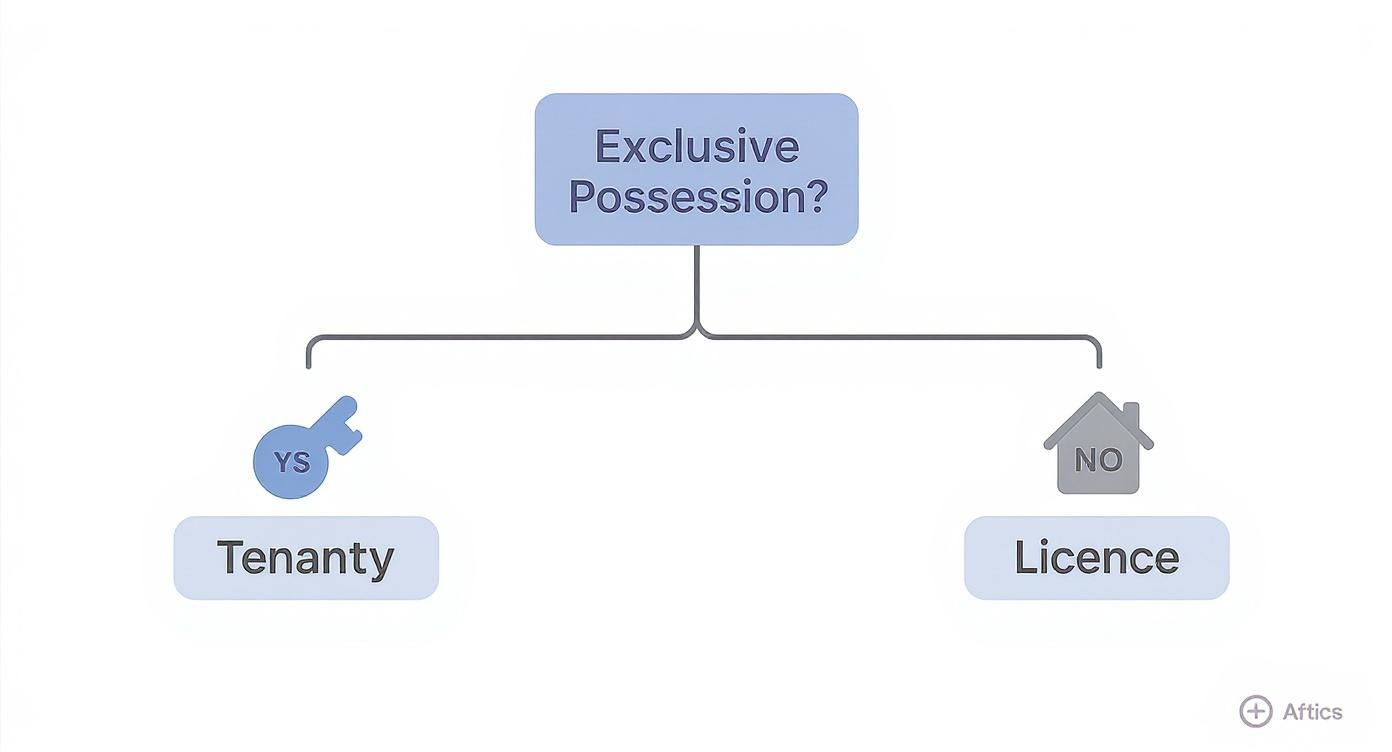
As you can see, the path splits entirely based on whether the occupant has the final say on who enters their space.
How Landlord Services Affect the Test
So, how can you clearly show a lack of exclusive possession and make sure you have a proper licence agreement? By providing regular services. This is a key strategy, especially for live-in landlords taking on a lodger.
When you, as the landlord, retain the right to enter the room to provide services, it completely undermines any claim of exclusive possession. It proves the occupant doesn't have total control over their space.
Examples of services that help define a licence include:
- Regular Cleaning: If you enter the room weekly to clean, it shows you still have access and control.
- Changing Bed Linen: Just like a hotel, providing fresh linen shows the arrangement is about receiving a service, not renting a self-contained unit.
- Providing Meals: While less common these days, this is another classic service that clearly points to a licence agreement.
Crucially, these services must be genuine. You have to actually carry them out. Just writing them into the agreement but never bothering to do them is a classic 'sham' clause, and a court would see right through it. Your actions must consistently match the terms of the licence. If they don’t, the legal reality shifts, potentially giving your licensee all the rights and protections of a tenant.
When a Licence Agreement Is the Right Choice
Knowing the theory is one thing, but knowing when to actually use it is what really counts. A licence agreement isn't some catch-all document you can use whenever you feel like it; it's a specific tool for very particular situations. Get it right, and you're protected. Get it wrong, and you could be walking into a legal minefield.
The most common, clear-cut case for a licence agreement is when you take a lodger into your own home. This is the classic scenario that this part of property law was built for.
The Resident Landlord and Lodger Scenario
The absolute cornerstone of a proper lodger agreement is that you, the landlord, must live in the same property. We’re not talking about another house you own down the road – it has to be your main home. This shared living arrangement is what fundamentally stops the lodger from having exclusive possession.
The legal line becomes even sharper when you share key facilities with your lodger. This nearly always includes:
- A shared kitchen where you both prepare meals.
- A shared bathroom used by everyone in the house.
- Shared living areas like the lounge or dining room.
This simple act of sharing communal spaces proves your constant presence and control over the whole property. Your lodger has permission to live there and use their room, but they never gain the kind of standalone control that would accidentally create a tenancy. This is the number one situation where a licence to occupy is not just the best choice, but the only correct one.
If you're thinking this route is for you, a good first step is to advertise your spare room for free to see who is looking in your area.
By living in the property and sharing facilities, the landlord inherently retains control and access, making a licence the legally correct format. The arrangement is fundamentally one of sharing a home, not leasing a private dwelling.
This setup gives you far more flexibility and involves fewer legal hoops to jump through compared to a formal Assured Shorthold Tenancy (AST), making it a brilliant option for homeowners with a spare room to fill.
Other Valid Uses for a Licence Agreement
While the lodger situation is by far the most frequent, a licence agreement is also the right document for a few other specific setups. Just like with a lodger, these arrangements all lack that key ingredient of exclusive possession.
1. Serviced Accommodation
Think of things like aparthotels or corporate short-term lets. If services like regular cleaning, linen changes, or maintenance are included in the deal, the provider needs to be able to get in and out without restriction. That need for access means the occupant can't have exclusive possession.
2. Certain Employer-Provided Housing
A licence often makes sense when an employee has to live somewhere specific to do their job properly. The classic example is a school caretaker who lives in a flat on the school grounds. Their right to be in the property is completely tied to their job; if the employment ends, so does their licence to occupy.
3. Short-Term Holiday Lets
This one’s straightforward. When someone rents a holiday cottage for a week, they’re doing so under a licence. They have permission to use the property for a very specific, short period for leisure. No one is pretending they are creating a long-term home.
4. Some Hostels and Guesthouses
In these places, guests are often just given a bed in a shared room. The management can move people between rooms whenever they need to. Because you don’t have one specific, exclusive space that is yours and yours alone, it’s a licence, not a tenancy.
In every one of these examples, the person is simply given permission to be there under a set of conditions. They are never handed the legal control that defines a tenancy. Using a licence in these contexts makes sure your paperwork matches the reality on the ground, keeping you legally compliant.
Crafting Your Licence Agreement: Key Clauses to Include

A well-drafted licence agreement is much more than a bit of paperwork. It’s your primary defence against misunderstandings and future disputes. Think of it as the instruction manual for the living arrangement you're creating. It lays everything out on the table, making sure both you and your licensee are on the same page about rights and responsibilities from day one.
Putting it all in writing is crucial. It protects everyone involved and gives you a clear point of reference if disagreements crop up. Cutting corners with a vague template is a recipe for trouble, potentially blurring the lines and accidentally creating a tenancy where you never meant to.
Let's break down the essential components that every solid licence agreement needs. Treat this as your practical checklist for building a document that’s clear, fair, and legally sound.
The Foundational Details
Before you get into the nitty-gritty, every agreement has to start with the basics. These clauses cover the who, what, where, when, and how much, forming the bedrock of the entire document. Get these wrong, and the rest of the agreement is built on shaky ground.
- Parties Involved: State the full names of the Licensor (that’s you, the landlord) and the Licensee (your lodger). Don't forget to include the full property address.
- The Property: Be specific about exactly what the agreement covers. Name the room the licensee will occupy and list all the shared areas they have permission to use, like the kitchen, bathroom, or living room.
- Term of the Licence: Clearly define the start date. Specify if it’s for a fixed term (say, six months) or if it’s a periodic arrangement that just rolls from one week or month to the next.
- The Licence Fee: This part needs to be crystal clear. State the exact amount to be paid, when it’s due (e.g., the 1st of every month), and how you want to be paid. Crucially, always use the term "licence fee" instead of "rent" to keep that legal distinction sharp.
Reinforcing the Licence Status
This is probably the most strategic part of your agreement. These clauses are specifically designed to reinforce that this is a licence, not a tenancy. They tackle the idea of exclusive possession head-on, making it obvious that you, the landlord, retain ultimate control over the property.
A non-negotiable clause here is the Landlord's Right of Access. You must clearly state that you have the right to enter the licensee's room at reasonable times for tasks like inspections, cleaning, or repairs. This clause alone is a powerful tool to prevent an accidental tenancy from being created.
It also helps to add a sentence explicitly stating that the agreement does not grant exclusive possession and is simply personal permission to occupy the room. It’s a great way to manage expectations and provides clear evidence of what everyone agreed to at the start.
A licence agreement isn't about restricting the occupant; it's about defining the boundaries of the permission they've been granted. Clauses that clarify the landlord's retained control are essential for maintaining the agreement's legal integrity.
Setting House Rules and Responsibilities
This is where you handle the day-to-day practicalities of sharing your home. Good house rules prevent friction and help everyone live together harmoniously. Being specific here leaves no room for confusion down the line.
Your agreement should clearly outline rules on:
- Guests: Are overnight guests okay? If so, how often, and do you need a heads-up?
- Noise: It's always wise to set reasonable quiet hours, especially during the week.
- Cleaning: Define who cleans what. Is the licensee responsible for their room and expected to chip in with cleaning the shared spaces?
- Smoking and Pets: State your policy clearly. Is smoking allowed anywhere on the property? Are pets a definite no-go?
Including these rules directly in the agreement gives them real weight. For a wider view on how legal documents are put together, resources on understanding general terms and conditions can offer useful context for drafting your own clauses.
A simple checklist can help ensure you've covered all the essential clauses.
Essential Licence Agreement Clause Checklist
| Clause Category | Purpose | Example Wording Hint |
|---|---|---|
| Parties & Property | To identify who and what the agreement covers. | "This agreement is made between [Licensor Name] and [Licensee Name] for the room at [Property Address]." |
| Licence Fee | To define payment terms clearly. | "The licensee agrees to pay a licence fee of £XXX on the first day of each month..." |
| Term & Termination | To set the duration and notice period. | "This licence is periodic, beginning on [Date]. One month's notice is required by either party..." |
| Landlord's Access | To reinforce the licence status (no exclusive possession). | "The licensor reserves the right to enter the room at reasonable times for inspection or repairs." |
| Use of Shared Areas | To clarify which parts of the house can be used. | "The licensee has permission to use the shared kitchen, bathroom, and living room." |
| House Rules | To set behavioural expectations (guests, noise, etc.). | "Overnight guests are permitted a maximum of [X] nights per month with prior notice." |
| Licensee Obligations | To outline responsibilities (e.g., cleanliness, reporting damage). | "The licensee must keep their room in a clean and tidy condition and report any maintenance issues promptly." |
This table isn't exhaustive, but it covers the core components every landlord should include to create a robust and clear agreement.
Ending the Agreement
Finally, your agreement must have a clear exit strategy. One of the main benefits of a licence is the simpler termination process compared to a tenancy, and your document should reflect that.
The Notice Period clause is vital. It should specify exactly how much notice either you or the licensee must give to end the agreement. For a periodic licence, this is usually tied to the payment period (e.g., one month's notice for monthly payments). This avoids any arguments over what "reasonable notice" means later on.
By meticulously including these key clauses, you create a comprehensive document that not only defines the legal relationship but also serves as a practical guide for peaceful cohabitation.
Avoiding Sham Agreements and Common Landlord Pitfalls
This is where many landlords, especially those new to letting a room, can get into hot water. It’s all too easy to accidentally create what’s known as a sham agreement. This is a document you’ve called a ‘licence’, but in practice, the living arrangement is a tenancy.
Make no mistake, the courts have seen this a thousand times. They will always look past the label on the paper and focus on the reality of the situation on the ground.
If your actions give the occupier the rights of a tenant, no piece of paper is going to save you. Getting this wrong can completely wipe out all the benefits of using a licence in the first place, so understanding the common tripwires is crucial to protecting yourself from costly legal battles.
At the end of the day, it nearly always comes back to that crucial concept: exclusive possession. If your behaviour gives the impression that the licensee can lock you out and treat their room as their own private fortress, you’re on very thin ice.
The Lock and Key Mistake
This is one of the most common and easily avoidable errors. Giving your lodger a lock on their door is perfectly fine; it gives them a sense of privacy and security. The critical mistake is not keeping a spare key for yourself.
That one simple action sends a powerful message: it implies they have the right to exclude you. By not having a key, you've physically given away your ability to access the room, which is a fundamental right of a resident landlord under a licence agreement.
The law sees this as you handing over control. Always, always keep a duplicate key. More than that, make sure your agreement explicitly states you have the right to use it for reasonable access, like for inspections or emergencies.
Similarly, even if you do have a key, promising you’ll never enter without their express permission could land you in the same trouble. Your day-to-day actions and verbal assurances have to match what’s written in the licence.
When Privacy Bleeds into Possession
Another trap is giving the occupier a bit too much independence, blurring the line between a lodger sharing your home and a tenant in a self-contained flat. This often happens gradually, usually with the best intentions of being a considerate, hands-off landlord.
For instance, if you stop providing any services (like occasional cleaning of common areas), never enter their room to check on things, and generally treat their space as entirely their own, you’re weakening your case. The whole arrangement starts to look less like a shared home and much more like a standard tenancy.
The legal test is brutally simple: Does the landlord's day-to-day conduct allow the occupier to live as if they have their own private, self-contained space? If the answer is yes, a court is highly likely to decide a tenancy has been created, no matter what you called the agreement.
This is why how you act is just as important as the document you both signed. Consistency is your best friend here.
The Serious Consequences of Getting It Wrong
Creating a sham agreement isn't a slap on the wrist. It’s a serious mistake with severe legal and financial fallout. Once a court decides the arrangement is actually a tenancy, a whole host of legal duties are triggered, and they apply retroactively.
Here are the biggest headaches you’ll face:
- Security of Tenure: Your "licensee" is now a tenant, with all the legal protections that come with it. You can't just ask them to leave with reasonable notice anymore. You'll have to use the formal, often lengthy, and expensive eviction process involving Section 21 or Section 8 notices and a court order.
- Deposit Protection: If you took a deposit, you’ve broken the law by not protecting it in a government-backed scheme within 30 days. A court can order you to repay the full deposit plus a penalty of up to three times its value.
- Repair Obligations: You’re now bound by the much stricter repair duties laid out in the Landlord and Tenant Act 1985. These are far more demanding than the general duty of care you owe to a licensee.
For a homeowner who just wanted to rent out a spare room, these outcomes are a nightmare. You're suddenly tangled up in the very legal complexities you were trying to avoid, all because of a few small missteps in how you managed the arrangement. The takeaway is clear: ensure your actions always, and consistently, reflect the licence you’ve signed.
How to End a Licence Agreement Correctly
Bringing a licence agreement to a close is a world away from ending a formal tenancy. For resident landlords, one of the biggest draws of a licence is just how straightforward it can be – you get to sidestep the complex court procedures tied to an Assured Shorthold Tenancy (AST). But simpler doesn't mean you can just wing it. Getting the process right is crucial for a smooth and lawful conclusion.
Unlike a tenancy, you don’t need to get a court order to get a licensee to leave. The whole thing hinges on one key concept: giving "reasonable notice". This is the absolute cornerstone of ending a licence the right way.
So, What Counts as Reasonable Notice?
What exactly is "reasonable"? While the law doesn't give a black-and-white definition, the accepted practice is brilliantly simple. You just match the notice period to how often the licensee pays you. It’s a common-sense approach that’s fair for everyone.
- Paying monthly? Give them one full month's notice.
- Paying weekly? One week's notice is considered perfectly reasonable.
Giving this notice officially revokes the permission you gave the licensee to live in your property. The moment that notice period is up, their right to be in your home is over.
Always, always put the notice in writing. A quick chat might feel less formal, but a written letter or email creates a dated paper trail. It's your best protection if any disagreements pop up later on.
You don't need to draft a complicated legal document. A simple, clear note stating the final date of the licence is all it takes.
What if a Licensee Refuses to Leave?
Most of the time, once you've given proper notice, your licensee will pack up and move on. But what if they dig their heels in? This is where the difference between a licence and a tenancy really hits home.
Because the licensee has no legal stake in the property, they become a trespasser the minute their notice expires. At this point, you are legally allowed to change the locks on their room to stop them from coming back in.
However, you have to tread very carefully here:
- Give a Clear Warning: State in your written notice that if they don’t leave by the specified date, they will be considered a trespasser and the locks will be changed. This puts everything on record.
- Act Peacefully: You can refuse them re-entry, but you absolutely must not use force, threats, or intimidation. Keep it calm and civil.
- Return Their Belongings: You are legally required to make sure they can collect their possessions. Arrange a time for them to do this safely.
This ability to take matters into your own hands is a massive advantage of a licence agreement. But it has to be done peacefully and by the book to avoid any risk of being accused of an illegal eviction.
Your Licence Agreement Questions Answered
We get it—the legal bits and pieces of a licence agreement can feel a bit confusing. Let’s cut through the noise and tackle the most common questions we see from both live-in landlords and lodgers. Here are some clear, straight-up answers to help you feel confident about your arrangement.
Key Questions on Licences
Can a lodger have a lock on their door?
Yes, they absolutely can. However, and this is a big one, you as the landlord must keep a spare key. You also need the right to enter the room for reasonable purposes, like doing a quick inspection or sorting out some cleaning. If you don't keep a key, you could accidentally create a tenancy because it suggests the lodger has exclusive control over their space.
Do I have to protect a lodger's deposit?
No. For a genuine licence where you're living in the same property, you are not legally required to protect the deposit in a government-backed Tenancy Deposit Scheme (TDS). That said, it's always good practice to provide a clear, written receipt for the deposit. It just keeps things transparent.
What happens if I, the landlord, move out?
This is a game-changer. If you move out of the property, the legal foundation for the licence agreement completely crumbles. In almost every case, the lodger's arrangement will automatically convert into an Assured Shorthold Tenancy (AST) by law. This gives them a whole host of new rights and protections you need to be aware of.
Is a licence suitable for a House in Multiple Occupation (HMO)?
Generally, no. If you don't live in the HMO yourself, the people renting the rooms will be tenants with proper Assured Shorthold Tenancies, not licensees. A licence is really only designed for the classic lodger setup where they are sharing a home with a resident landlord.
For trickier situations or specific legal advice tailored to you, it's always a smart move to get some professional guidance. If you need to chat through your circumstances, feel free to get in touch with our team for a bit of support.
At Rooms For Let, we make it simple to find the right person for your spare room. List your room for free today!