So, you’re thinking about renting out your house or a spare room? It’s a brilliant way to bring in some extra income, but success starts long before you even think about placing an advert. Getting it right from the beginning saves a world of headaches later on.
The first moves you make are the most important. It's not just about giving the place a quick Hoover; it's about creating a safe, appealing, and legally sound home that will attract the right kind of person. This early groundwork really does set the tone for your entire journey as a landlord.
Your first job? Stop seeing the property as your home and start looking at it through a renter's eyes. That quirky little feature you love might be a major turn-off for someone else. Start with a proper, deep clean and tackle all those little jobs you’ve been putting off, from the dripping tap in the bathroom to the scuff marks in the hallway.
Getting Your House Rent-Ready
Making your property 'rent-ready' means creating a blank canvas that feels fresh, welcoming, and ready for someone to make their own. It’s about practicality as much as presentation.
- Declutter and Depersonalise: This one is huge. Pack away the family photos, the holiday souvenirs, and any general clutter. A potential renter needs to be able to picture their life in the space, not feel like they're stepping into yours.
- Tackle Essential Repairs: Get everything working as it should. Leaky taps, doors that don’t quite close, cracked tiles, dodgy light fittings – fix them all. A well-maintained property tells a renter you’re a landlord who cares.
- A Fresh Lick of Paint: You can’t go wrong with neutral colours. Think off-white, pale grey, or soft beige. They make rooms look bigger, brighter, and appeal to the widest audience. It’s amazing what a difference it can make.
You'll also need to decide whether to let the property furnished or unfurnished. Unfurnished is often a magnet for longer-term tenants who have their own stuff. Furnished properties, on the other hand, are perfect for students, young professionals, or people relocating who just want to move straight in. If you go down the furnished route, make sure everything is in good nick and meets current fire safety regulations.
Tenant or Lodger? The Critical Distinction
Right, before you go any further, you need to get your head around the legal side of things. The single biggest question to answer is this: will you be living in the property alongside the person renting from you?
This determines whether you’ll have a tenant or a lodger, and UK law treats them very, very differently.
A landlord-tenant relationship is a formal, business arrangement with strong legal protections for the tenant. A homeowner-lodger relationship is more of a personal arrangement, giving the homeowner much more flexibility because you're sharing your main home.
A tenant will almost always have an Assured Shorthold Tenancy (AST). This gives them 'exclusive possession' of at least part of the property, meaning you can't just wander into their room without giving proper notice (usually 24 hours).
A lodger (also known as an 'excluded occupier') is someone who rents a room in your main home and shares communal spaces like the kitchen or bathroom with you. As a resident landlord, you have the right to enter their room, and ending the arrangement is much simpler—you only need to give 'reasonable notice' instead of going through a formal eviction process.
Deciding which route to take is probably the most crucial decision you'll make at this stage. To help you get started on the right foot, you can find loads of great resources when you register as a landlord with Rooms For Let and begin your journey.
To make this clearer, here’s a breakdown of the main differences between taking on a tenant and having a lodger.
Tenant vs Lodger: Key Differences for UK Landlords
This table highlights the core distinctions that will affect your rights and responsibilities as a landlord or homeowner.
| Aspect | Tenant (Assured Shorthold Tenancy) | Lodger (Excluded Occupier) |
|---|---|---|
| Legal Status | Has a formal tenancy agreement (usually an AST) with robust legal rights. | Has a licence to occupy. Not a tenant, so has fewer legal protections. |
| Your Status | Landlord. You may or may not live in the same building, but not the same home. | Resident Landlord. You must live in the property as your main home. |
| Deposit Protection | Legally required to protect the deposit in a government-approved scheme. | Not legally required to use a deposit protection scheme. |
| Right to Access | Cannot enter the tenant's private space without giving at least 24 hours' notice. | Can enter the lodger's room without notice (though it's polite to agree on rules). |
| Ending the Agreement | Must follow a formal eviction process (e.g., Section 21 or Section 8 notice). | Only requires 'reasonable notice' to be given (usually the rental period, e.g., one month). No court order needed. |
| Repairs | Legally responsible for most major repairs to the property structure and utilities. | Still responsible for safety, but repair obligations can be less formal. |
| Tax Implications | Standard rental income rules apply. | Can benefit from the government's Rent a Room Scheme, earning up to £7,500 tax-free. |
Understanding these points is fundamental. Choosing the lodger route offers simplicity and control if you're sharing your own home, while a formal tenancy is the standard for renting out a separate property. Getting this right from day one will save you a lot of potential trouble down the line.
Getting Your Property Legal and Safe
Right, you’ve figured out how you want to rent your property. Now for the really crucial bit: making sure everything is above board, legal, and safe. When you decide to rent out your house in the UK, you’re officially becoming a landlord. That title comes with a hefty set of responsibilities that you simply can't afford to ignore.
Getting this stuff wrong can lead to some eye-watering fines or even legal trouble. Think of these obligations as the solid foundation of your rental venture. They’re not just bureaucratic hoops to jump through; they’re about providing a genuinely safe and decent home for someone.
The 'Big Three' Safety Certificates
Before anyone even sets foot in the property as a tenant, you absolutely must have three key safety certificates sorted. These are non-negotiable, and you'll need to hand copies over to your new tenants right at the start of their tenancy.
- Gas Safety Certificate (CP12): Got a gas boiler, hob, or fire? Then you need a Gas Safe registered engineer to check them over every single year. This check confirms everything is working as it should and, most importantly, that there are no dangerous leaks.
- Electrical Installation Condition Report (EICR): This is a deep dive into the property's fixed electrical systems. A qualified electrician needs to carry out this inspection at least every five years. It’s a legal must-have, and your tenants need a copy of the report.
- Energy Performance Certificate (EPC): This certificate gives your property an energy efficiency score, from A (brilliant) down to G (not so good). Since 2018, any rental property has to achieve at least a grade 'E'. The certificate itself lasts for 10 years, and you have to make it available for tenants to view.
Making sure you’ve sorted the essential gas safety checks for landlords is probably one of the most critical parts of your duty of care.
This flowchart is a great way to visualise how your living situation changes your legal responsibilities.
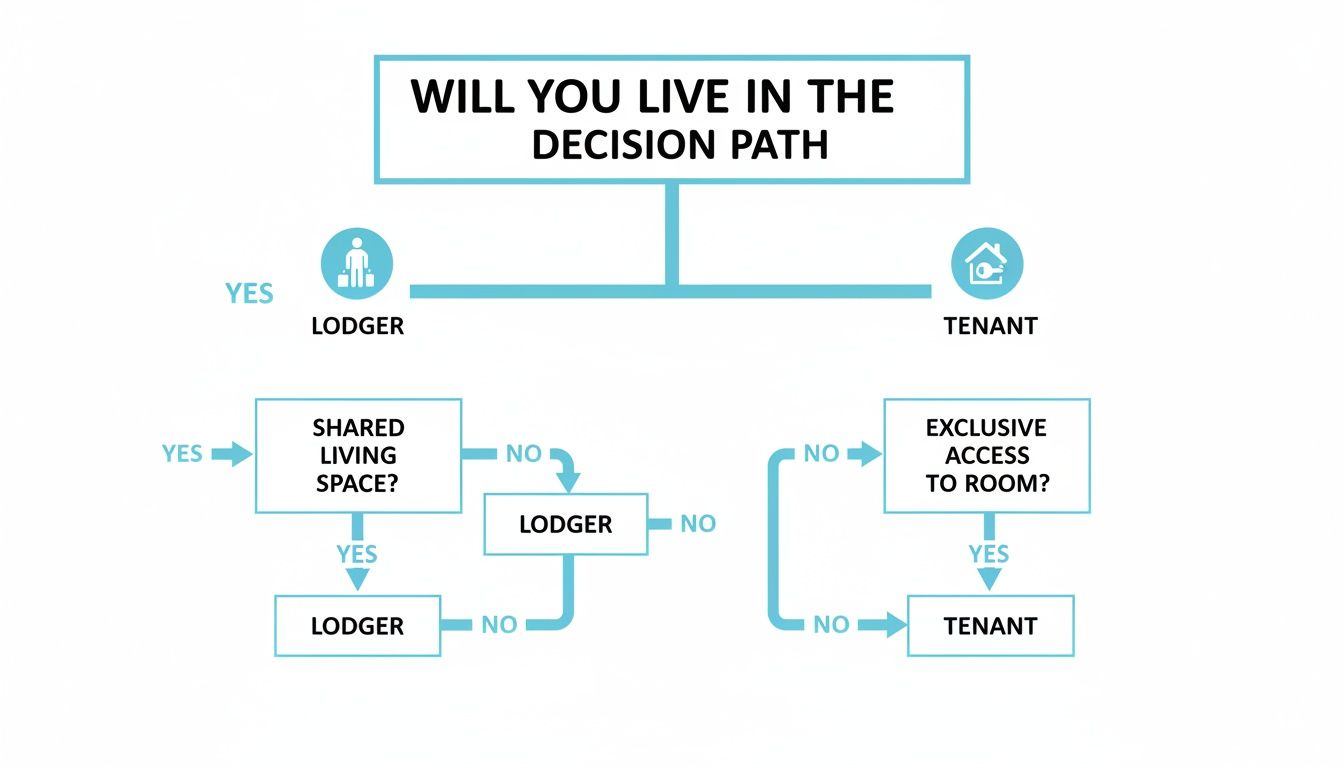
As you can see, whether you're living in the property or not makes a huge difference. It affects everything from how you can end the agreement to your tax situation.
Fire Safety: Alarms and Furnishings
Fire safety is another area where the rules are crystal clear. Your job is to make sure there are early warning systems in place, should the worst happen.
Here’s what you must do:
- Fit at least one working smoke alarm on every floor of your property that's used as living space.
- Install a carbon monoxide alarm in any room with a solid fuel appliance, like a log burner or an open coal fire.
It's also down to you to test these alarms and make sure they’re working on day one of the tenancy. After that, it’s the tenant's job to test them regularly, but the initial check is all on you.
Landlord Tip: At the start of the tenancy, get your tenant to sign a simple checklist confirming the alarms were tested in front of them and were working. It's a small piece of paper that can save a world of headaches later on.
If you’re letting the place furnished, there’s another layer. Any sofas, beds, or other soft furnishings you provide must meet fire safety standards. Just look for the labels confirming they comply with the Furniture and Furnishings (Fire) (Safety) Regulations 1988.
Is Your Property an HMO?
This is a big one. You need to work out if your property is considered a House in Multiple Occupation (HMO), because if it is, a whole new set of rules kicks in.
Generally, a property is an HMO if at least three tenants live there who aren't from the same 'household' (i.e., not a family), and they share a kitchen, bathroom or toilet. If you’re renting to five or more people like this in England or Wales, you will need a mandatory HMO licence.
Be warned, though. Many local councils have their own 'additional licensing' rules that can apply to smaller HMOs, so you must check your local authority’s website. The fines for running an unlicensed HMO are unlimited, so it's not worth the risk.
Don't Forget Right to Rent Checks
Last but by no means least, you have a legal obligation to check that any adult planning to live in your property has the right to rent in the UK. This applies to every single adult, even if their name isn't on the tenancy agreement.
The process involves checking their original documents—like a UK passport or a permanent residence card—with the person physically present. You then need to take copies and keep them safe for the entire tenancy, plus one year after they move out.
Skip this step, and you could be facing a fine of up to £3,000 per tenant. It’s a straightforward check, but the penalty for getting it wrong is severe. Nailing all these legal and safety points is the bedrock of being a good, and successful, landlord.
Setting the Right Rent to Attract Great Tenants
Nailing the right price for your rental is probably one of the biggest calls you’ll make as a landlord. Go in too high, and you’ll be greeted by silence, leaving you with an empty property that’s costing you money every day. Price it too low, and you're not just leaving cash on the table; you might also attract a flood of applicants who aren't the right fit.
The real goal here is to find that sweet spot. It’s about setting a competitive price that truly reflects your property's value on the local market, attracts the kind of reliable tenants you’re looking for, and makes the whole venture worthwhile. This isn’t a guessing game – it’s a bit of strategy mixed with solid research.

Researching Your Local Rental Market
First things first, you need to become a bit of an expert on your local patch. The best way to do this is by seeing what similar properties in your immediate area are actually renting for. And don’t just glance at the headline price – dig into the details.
- Property Type: Make sure you're comparing apples with apples. If you have a three-bedroom semi-detached, look at other three-bed semis, not two-bed flats. It makes a huge difference.
- Condition: Now for a moment of honesty. Is your place freshly refurbished with a brand-new kitchen, or is it looking a little tired? Be realistic and price it accordingly.
- Location Specifics: Even a few streets can change everything. Is your house a five-minute walk from the station? Near that outstanding primary school? These are tangible benefits you can factor into the price.
Hop onto platforms like Rooms For Let and see what other landlords are currently charging. A really useful tip is to check how long some listings have been up. If you see the same property sitting there for weeks on end, chances are it's overpriced.
It's also worth knowing the bigger picture. The UK rental market is constantly shifting. Right now, average monthly private rents have hit £1,368 as of December 2025, which is a 4.0% jump in just 12 months. That strong demand means landlords, on average, are earning an extra £52 a month compared to last year. Getting familiar with these private rental market statistics helps you understand where your property fits in.
Creating a Listing That Gets Noticed
Once you've landed on a competitive price, it's time to craft an advert that actually makes people stop scrolling and book a viewing. Think of your listing as your shop window.
High-quality photos are completely non-negotiable. Don’t just take a few hurried snaps on your phone. Wait for a bright day, throw open the curtains, and switch on every light to make the place feel warm and inviting. Have a good tidy-up, declutter, and really show off the property’s best features.
Pro Tip: Your main photo is your hook. Choose a shot of the most impressive space – maybe it's the bright, airy living room or the modern kitchen. This is the image that will make someone click on your ad over someone else's.
Next, your description needs to be more than just a list of rooms. It needs to tell a story.
- Paint a Picture: Instead of writing "living room," try "a bright, south-facing living room with original wooden floors."
- Highlight Key Features: Got a new boiler, off-street parking, or a lovely private garden? Shout about it! Mentioning the proximity to local shops and parks adds real value.
- Be Clear and Honest: State the rent, the deposit, and exactly what bills are included. Transparency right from the start helps build trust with potential tenants.
Effective Marketing on the Right Platforms
To find the right people, you need to be advertising where they’re actually looking. This is where specialised platforms really come into their own, connecting landlords directly with people who are actively searching for a new home.
Posting your property on a dedicated site like Rooms For Let puts your advert in front of thousands of potential tenants every single day. These platforms are designed for the rental market, giving you the tools to manage enquiries and connect with suitable people far more efficiently. Think about who you're trying to attract – students, young professionals, or families? Tailor the tone of your listing and the features you highlight to appeal directly to them.
Ultimately, effective marketing is that perfect blend of a great price and a brilliant listing. Get it right, and you'll spend less time worrying about empty rooms and more time enjoying the benefits of a successful let. When it comes to advertising, exploring different options can give your visibility a real boost. If you're wondering which route to take, you might find it helpful to check out our guide on choosing the right advert package for your property.
How to Vet Applicants and Secure Your Tenancy

You’ve set the right rent and your listing is pulling in enquiries. Now for what is, without a doubt, the most important part of being a successful landlord: choosing the right person to live in your property.
A great tenant pays on time, looks after the place as if it were their own, and keeps in touch. The wrong one? Well, that path leads to stress, sleepless nights, and financial headaches you just don't need.
This is where a thorough, fair, and consistent vetting process becomes your greatest asset. It’s not about being cynical; it’s about making a sound business decision to protect what is likely your biggest investment. Let’s walk through how to go from a simple enquiry to a fully secured tenancy.
Conducting Effective Viewings
The viewing is your first real chance to meet potential tenants and get a gut feeling for whether they’d be a good fit. It’s a two-way street—they’re sizing up the property and you, just as much as you’re assessing them. A bit of organisation here can be incredibly insightful.
Try to arrive a little early to switch on lights and open a few windows. It creates a much more welcoming feel. I’ve always found it’s better to conduct individual viewings rather than a chaotic open-house event. It gives you the space to actually talk to each applicant properly.
During the viewing, listen to the kinds of questions they ask. Are they thoughtful, showing genuine interest in the property and the local area? Or is their first question about how low you’ll go on the rent before they’ve even seen the second bedroom?
A few good questions to have ready include:
- “So, what’s prompting the move?”
- “When are you hoping to move in?”
- “Who would be living at the property?”
- “Just to check, do you have any pets or are any of you smokers?”
A Word of Warning: Be wary of applicants who are overly keen to pay several months' rent upfront in cash, especially if they try to rush or bypass the referencing checks. While it can seem like a great offer, it can also be a red flag for someone trying to hide a poor rental history or dodge affordability checks.
The Formal Referencing Process
Once you’ve met a promising applicant, it’s time to look past the first impression and dig into the details with formal referencing. Whatever you do, never skip this step. This is your opportunity to verify everything they’ve told you and build a clear picture of their reliability.
A proper referencing check typically covers three key areas:
- Credit Check: This gives you a look at their financial history, flagging any County Court Judgements (CCJs) or bankruptcies. It doesn’t show their bank balance, but it reveals how responsibly they manage their financial commitments.
- Employment & Affordability Check: This involves contacting their employer to confirm their job title, contract type (permanent, temporary), and salary. As a solid rule of thumb, a tenant's gross annual income should be at least 30 times the monthly rent for the tenancy to be comfortably affordable.
- Previous Landlord Reference: This is absolute gold. A previous landlord can tell you if they paid rent on time, looked after the property, and were generally good to deal with. If you can, always try to get a reference from the landlord before their current one, too.
You don't have to do all this legwork yourself. Using a professional referencing agency is a small price to pay for a comprehensive report. It saves you time, keeps you compliant with data protection laws, and gives you real peace of mind.
Securing the Tenancy Agreement
You’ve found your ideal tenant and their references are sparkling. Now it's time to make it all official and legally watertight. This involves two critical elements: the tenancy agreement and the deposit protection.
An Assured Shorthold Tenancy (AST) is the standard contract used for renting out a whole property in England and Wales. This legal document sets out the rights and responsibilities for both you and your tenant.
At a minimum, it must clearly state:
- The names of everyone involved (landlord and all tenants).
- The full property address.
- The start and end dates of the tenancy.
- The monthly rent amount and the due date.
- The security deposit amount.
- Key obligations for both tenant and landlord (e.g., who is responsible for which repairs).
You can find model tenancy agreements online, but if you have any doubts at all, it's worth getting a solicitor or a landlord association to cast an eye over it. The law changes, and you need to be sure your agreement is fully compliant.
Handling the Security Deposit Correctly
Finally, you’ll take a security deposit (often called a tenancy deposit). This is a payment that acts as your safety net against unpaid rent or damage to the property. In England, the deposit is legally capped at five weeks' rent if the total annual rent is under £50,000.
This is critical: you can’t just pop this money into your own bank account. By law, you must protect it in one of three government-approved tenancy deposit schemes within 30 days of receiving the funds from your tenant.
The three approved schemes in England and Wales are:
You also have a legal duty to give your tenant the official 'Prescribed Information', which tells them exactly where their deposit is being held. Failing to protect the deposit correctly can lead to fines of up to three times the deposit amount and can prevent you from using a Section 21 notice to regain your property. Getting this right isn’t just about ticking a legal box; it’s the final, professional step to getting your tenancy off to a secure and proper start.
Managing Your Property Finances and Taxes
Once your tenant moves in, the game changes. You shift from the initial flurry of setup to the steady rhythm of ongoing management. This new phase is all about mastering the dual role of being a responsive landlord while keeping a sharp eye on the numbers. Honestly, getting this balance right is what separates a stressful side-hustle from a genuinely rewarding venture.
Your new routine will involve handling repairs efficiently, carrying out property inspections respectfully, and, crucially, keeping immaculate financial records. These are the day-to-day realities of being a landlord, and they’re every bit as important as the initial legal checks.
Declaring Rental Income to HMRC
Let's be clear: any money a tenant pays you is rental income, and HMRC needs to know about it. This isn't just the rent itself. If you bundle in costs for things like cleaning or utilities, that counts too.
Every year, you’ll need to declare this by completing a Self Assessment tax return. It sounds daunting, but it's a standard process for millions across the UK. The secret to a stress-free tax return is simple: keep meticulous records of every payment you receive. It makes filling out the form a million times easier when the time comes.
Understanding Allowable Expenses
Now for the good news. You don’t pay tax on your total rental income. You pay tax on your profit – that’s your income minus what HMRC calls 'allowable expenses'. These are the costs you rack up in the process of renting out your property, and tracking them is your best tool for reducing your tax bill.
Common allowable expenses include:
- Letting agent and management fees: If you're using an agent, their fees are fully deductible.
- Landlord insurance: Your specialist insurance policy is a key allowable expense.
- Maintenance and repairs: This is a big one. The cost of fixing a leaky tap, replacing a faulty boiler, or mending a fence can all be claimed. Just be aware this doesn’t cover property improvements.
- Accountancy and legal fees: Any costs for professional services related to the property letting are also deductible.
- Direct running costs: This covers things like ground rent, service charges, or other direct costs of owning the property.
A classic mistake is confusing a repair with an improvement. If you replace a tatty old carpet with a similar new one, that’s a repair. If you rip out that carpet and install premium solid oak flooring, that’s an improvement. You can’t claim for the improvement as an expense.
Getting your head around your tax obligations is non-negotiable. A dedicated buy-to-let tax calculator can be a great starting point to get a rough idea of what you might owe.
Why Specialist Landlord Insurance Is Non-Negotiable
Your standard home insurance policy is effectively useless the moment a tenant moves in. I can't stress this enough. The risks associated with a rental property are completely different, and you need a policy built specifically for that scenario.
Landlord insurance is designed to protect your investment with cover that standard policies just don't include. This usually covers:
- Loss of Rent: If a fire or flood makes your property uninhabitable, this covers your lost income while it's being fixed.
- Property Owners' Liability: This is crucial. It protects you if a tenant or visitor is injured at your property and you're deemed responsible.
- Alternative Accommodation: It can cover the cost of rehousing your tenants if they have to move out during major repairs.
Skipping this and sticking with your old policy is a huge gamble. If you ever need to make a claim, you'd likely find your insurance is void, leaving you to personally cover a potentially massive bill for repairs or legal costs.
Given the current market, this protection is more vital than ever. The rental market saw its available stock shrink by 200,000 properties in 2025, which has driven average rents outside London to a record £1,385. This scarcity makes your property a high-value asset, and protecting it properly is just common sense.
Still Have a Few Questions?
Once you’ve tackled the big legal and financial hurdles of becoming a landlord, the day-to-day reality of renting out your house begins. This is where the practical, everyday questions start to pop up. It's completely normal.
We get asked about these things all the time, from sorting out who fixes a leaky tap to navigating the tricky process of ending a tenancy. Let's run through some of the most common queries we see from new landlords.
Who Is Responsible for Which Repairs?
This is a classic point of confusion and a frequent source of landlord-tenant friction. Getting it clear from the start is crucial.
As the landlord, the big stuff is on you. Legally, you're responsible for keeping the property's structure and exterior in good shape. This covers the roof, walls, drains, and windows. You also have to make sure the essential services – water, gas, and electricity – are all working safely. Think of it as your duty to provide a safe and habitable home.
Your tenant's responsibility is to look after the place in what's often called a "tenant-like manner." This isn't about major construction; it's the small, day-to-day things. We're talking about changing light bulbs, testing the smoke alarms, and generally keeping the property clean and tidy. Crucially, they are also on the hook for fixing any damage they (or their guests) have caused.
Key Takeaway: The major structural and utility responsibilities fall to you. The day-to-day upkeep and repairs for any damage they cause fall to the tenant. Spell this out clearly in your tenancy agreement to save yourself a world of headaches later on.
For a deeper dive into landlord and tenant responsibilities, we have a wealth of articles over on the Rooms For Let blog.
How Much Notice Do I Give to End a Tenancy?
Ending a tenancy has to be done by the book, and the notice period depends entirely on the situation and the type of legal notice you use.
Here’s a breakdown for an Assured Shorthold Tenancy (AST):
- During a Fixed-Term Tenancy: You can't just ask a tenant to pack their bags mid-way through their contract unless they’ve broken the rules (like failing to pay rent). If they have, you’d need to serve a Section 8 notice.
- At the End of a Fixed-Term: If you simply want your property back when the agreed term finishes, you must give them at least two months' notice by serving a Section 21 notice.
- During a Periodic (Rolling) Tenancy: After a fixed term ends, if you don't sign a new contract, the tenancy automatically rolls over on a month-by-month basis. To end this, you still need to provide two months' notice using a Section 21.
Following the correct legal procedure here is non-negotiable. One wrong move, and your notice will be invalid, meaning you'll have to start the entire process from scratch.
Can I Increase the Rent?
Yes, you can, but it has to be done fairly and by following the rules. You can't just decide to hike the rent on a whim.
The easiest way is to have a rent review clause written into your tenancy agreement from the start. If you don't have one, you can propose a rent increase and have the tenant agree by signing a new tenancy agreement. The other formal route is to use a Section 13 notice, but this can only be done once a year for periodic tenancies.
Any increase must be realistic and reflect the going rate for similar properties in your local area. A quick look at what's happening in the market can be really helpful here. For instance, as we move through 2026, the UK rental market is showing a familiar pattern: a slight cooling month-on-month but a solid increase compared to last year.
Goodlord's data shows that in December 2025, the average rent in England was £1,214, down 2.5% from November but still up 2.4% year-on-year from £1,185. This kind of seasonal dip can be a strategic time for landlords to secure a great tenant at a strong annual rate before things heat up again. Keeping an eye on UK rental market trends for landlords is a smart way to inform your pricing strategy.
Ready to find the perfect tenant for your spare room or property? With Rooms For Let, you can advertise your space to thousands of active room-seekers across the UK. Our platform makes it simple, fast, and effective to connect with your next tenant. List your room today and fill your vacancy quickly. Visit us at https://www.roomsforlet.co.uk to get started.